
"How much will it cost?" is usually the first question a homeowner asks about spray foam, and the honest answer is that it depends. Two houses with the same floor plan can get very different quotes, and both can be fair.
ComfortSeal makes the foam. We don't install it, and we don't set installers' prices. Each certified installer quotes their own work. What we can do is explain what goes into a quote, share the published price ranges we could verify, and show you how to compare quotes line by line.
Published price ranges, and how to read them
Several home-improvement publishers track installed spray foam prices. Here are two we checked directly:
| Reported by | Open cell | Closed cell | Unit | ≈ per sq. ft. at 3.5 in.* |
|---|---|---|---|---|
| HomeGuide, Dec. 2025 | $1.50 – $3.50 | $3.00 – $5.00 | Per sq. ft. of insulated surface, installed | Already per sq. ft.; thickness not stated |
| Bob Vila (2021, updated 2024; figures from Angi and HomeAdvisor) | $0.44 – $0.65 | $1.00 – $1.50 | Per board foot, installed | Open cell $1.54 – $2.28; closed cell $3.50 – $5.25 |
*Our arithmetic, not the publisher's: board-foot prices multiplied by 3.5 to approximate one square foot of foam at 3.5 inches, the depth of a 2x4 cavity. Both pages also print energy-savings and payback claims, which we don't repeat here because they depend on the individual house.
A few things to keep in mind when you read ranges like these:
- They're national averages from third-party publishers, not ComfortSeal prices. Your quote may land inside, above or below them.
- Square feet means surface area, not house size. HomeGuide notes its figures are based on the square feet of surface being insulated, not the floor area of the home. A 2,000-square-foot house can have far more (or less) than 2,000 square feet of walls and roof deck to foam.
- Small jobs have minimums. HomeGuide reports that many spray foam companies charge minimum job fees of $1,000 to $2,000 or more, so a small rim joist or bonus room job can cost more per square foot than a whole house.
Even the Department of Energy says costs "vary greatly." Its Consumer Guide to Home Insulation tells homeowners to check with a local contractor for actual costs. That's our advice too.
Board feet: the unit behind most quotes
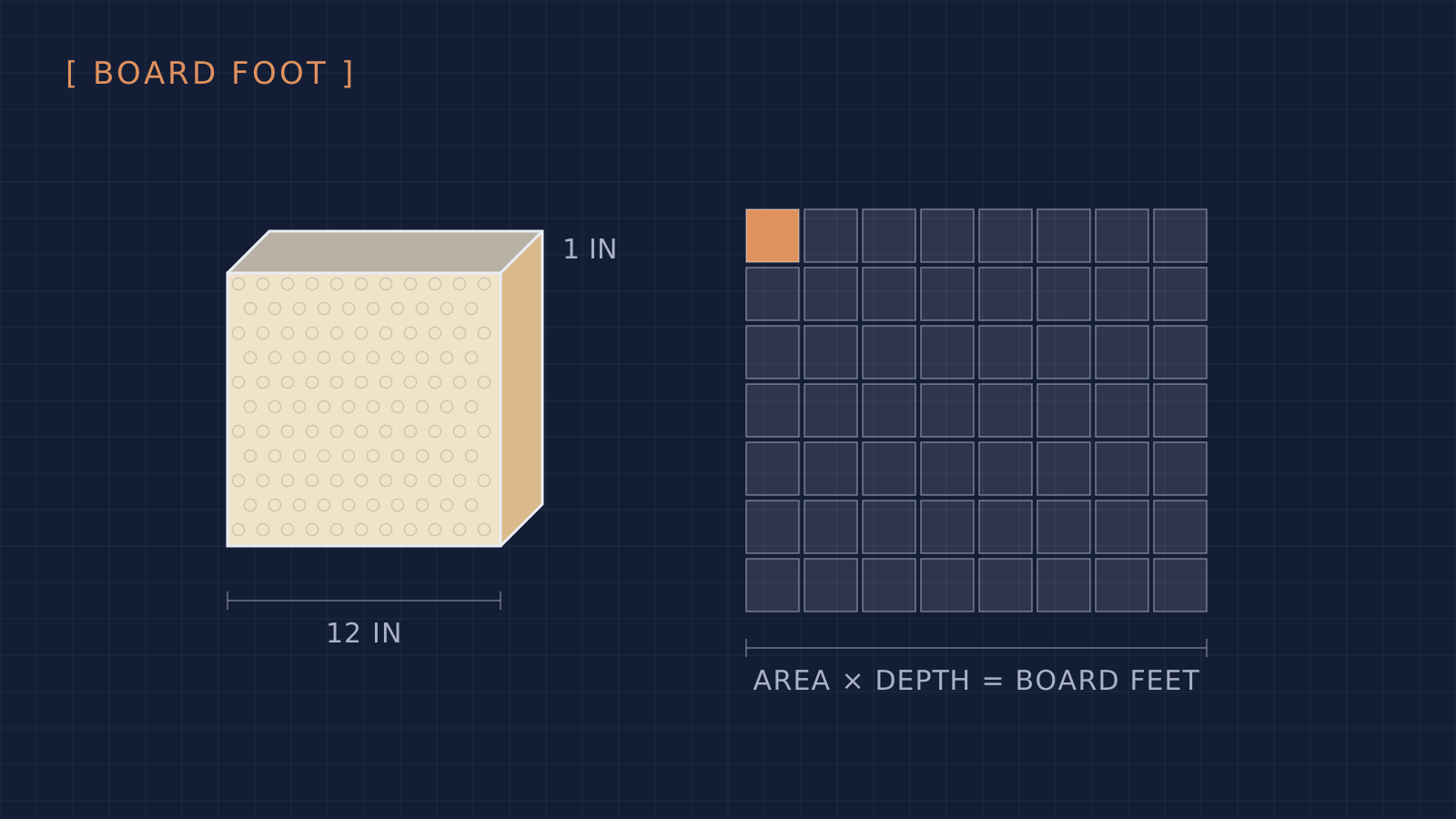
Spray foam is often priced by the board foot: one square foot of foam, one inch thick. Multiply the area by the thickness and you have the board feet. For example, 1,000 square feet of roof deck at 5.5 inches is 5,500 board feet.
That same example shows why comparing prices per board foot isn't the whole story. At 5.5 inches, IAPMO's evaluation reports list ComfortSeal 500 open cell at R-20 and ComfortSeal HFO closed cell at R-39. Same board feet, very different R-value. What you're really buying is the R-value, air sealing and moisture control in each part of the house.
The higher the R-value, the greater the insulating power. Ask your seller for the fact sheet on R-values.
What drives the price
1. Open cell or closed cell. Closed cell foam uses more material for each inch installed. ComfortSeal HFO expands roughly 15 times its liquid volume, while ComfortSeal 500 expands roughly 100 times. That's why closed cell costs more per board foot in both published ranges above. In exchange, it delivers more R-value in the same depth (R-25 at 3.5 inches vs. R-13 for open cell) and acts as a Class II vapor retarder at 2 inches. The two foams do different jobs; see open cell vs. closed cell.
2. Thickness. More thickness means more board feet. The thickness comes from the R-value you're aiming for, which depends on your climate zone, local code and the part of the house. Spray foam R-value doesn't rise in a straight line with thickness, so ask for the R-value from the product's evaluation report at the thickness being installed. Our R-value calculator uses those published tables.
3. How much area, and where. Larger jobs usually cost less per square foot because crews work more efficiently, and HomeGuide notes the part of the house affects thickness and complexity. A roofline, a set of rim joists and a crawl space are three very different jobs.
4. Access. HomeGuide reports labor at $0.50 to $2.00 or more per square foot and says installation costs less in open attics and unfinished basements than in tight crawl spaces or finished walls. Steep roofs and tight, low spaces add time.
5. Prep and removal. Before foam can go in, surfaces have to be clean, and old insulation often has to come out. HomeGuide puts insulation removal at $1.00 to $2.50 per square foot. Bob Vila reports $1.50 to $3.00 per square foot for machine removal (2024) and says opening up drywall in an existing home adds to the cost. New construction, with open walls, is usually the simplest case. Masking windows, floors and equipment is part of the prep too.
6. Coatings. Some areas need an ignition barrier or thermal barrier over the foam, and that's added material and labor. It depends on the product and where it's installed:
- ComfortSeal 500 in attics and crawl spaces needs an ignition barrier. IAPMO ER-974 Table 5 recognizes DC315 at 6 wet / 4 dry mils or No-Burn Plus ThB at 4 wet / 3 dry mils.
- ComfortSeal HFO needs no coating in attics and crawl spaces entered only to service utilities, up to 10 inches on the roof deck and 6 inches on walls, when the conditions in ER-975 Section 4.5.2 are met.
- Foam in living areas must be covered by a thermal barrier, such as ½-inch drywall, or an approved coating assembly listed in the evaluation report.
Our guide to ignition barriers vs. thermal barriers explains the difference.
7. Region. Labor rates vary from market to market, and HomeGuide notes that labor cost depends on local rates as well as how complex the job is. Travel distance to the job can play a part too. That's one more reason a national average rarely matches a local quote.
8. Related work. Some projects bring in other trades. Moving the envelope to the roofline in an unvented attic can change your HVAC needs. Closing a crawl space means a ground vapor retarder and a drying method under IRC R408.3 (see spray foam in crawl spaces). Ask whether these are in the quote or handled by someone else.
How to compare quotes
Get every quote in writing, and make sure each one spells out the same things, so you're comparing like with like:
- Product for each area, by name (for example, ComfortSeal 500 or ComfortSeal HFO).
- Thickness for each area, and the R-value that thickness gives according to the product's evaluation report.
- Area and board feet, or square feet at a stated thickness.
- Coatings: whether an ignition barrier or thermal barrier is needed, which product and at what thickness, and whether it's included.
- Prep, removal and cleanup: what's included and what isn't.
- Re-entry time: when you'll need to leave the house, and when it's safe to come back.
- Certification and warranty, in writing.
A lower price for thinner foam, or for a quote that leaves out a required coating, isn't a better deal. If two quotes differ a lot, the answer is usually in one of the lines above.
What about energy savings?
You may see articles that promise a specific savings figure or a set number of years to earn back the cost. We don't publish those numbers, because they depend on things no general article can know: your house, your climate, how leaky the home is today, what the foam replaces and how you heat and cool. Under the Federal Trade Commission's R-value Rule (16 CFR 460), anyone who claims insulation will cut fuel bills needs a reasonable basis for the claim. The rule's own wording says it well: "Savings vary. Find out why in the seller's fact sheet on R-values. Higher R-values mean greater insulating power."
If an installer gives you a savings estimate, ask how it was calculated and what assumptions it uses. For the physics behind it, see why air sealing matters for energy bills.
Why the installer matters
Spray foam is made on site, so the quality of the job is decided on installation day. Both IAPMO evaluation reports require ComfortSeal foam to be installed by installers certified by USAFoam, LLC, the company that makes it (ER-974 Section 2.2 and ER-975 Section 2.5). Installs by certified ComfortSeal installers carry a limited lifetime warranty on the foam, for the life of the home; installation workmanship is the installing contractor's responsibility. See the warranty page for details.
Spray foam price comes down to foam type, thickness, area, access, prep, coatings and local labor. Published ranges are a starting point, not a quote. Get a written quote from a certified installer that lists the product, thickness, R-value and coatings for every area.
Ready for real numbers on your house? Find a certified ComfortSeal installer and ask for a written quote. If you're still deciding whether foam is right for you, read is spray foam insulation worth it?
Frequently asked questions
How much does spray foam insulation cost per square foot?
HomeGuide (Dec. 2025) reports $1.50 to $3.50 per square foot installed for open cell and $3.00 to $5.00 for closed cell; Bob Vila reports $0.44 to $0.65 and $1.00 to $1.50 per board foot. These are national third-party averages, not ComfortSeal prices, and your quote may land above or below them.
What is a board foot of spray foam?
One square foot of foam, one inch thick. Multiply area by thickness to get board feet: 1,000 square feet of roof deck at 5.5 inches is 5,500 board feet. Board feet alone don't tell you what you're buying, because at 5.5 inches ComfortSeal 500 is R-20 and ComfortSeal HFO is R-39 (IAPMO ER-974 and ER-975).
Why does closed cell spray foam cost more than open cell?
Closed cell uses more material per inch installed: ComfortSeal HFO expands roughly 15 times its liquid volume, ComfortSeal 500 roughly 100 times. In exchange, closed cell delivers R-25 at 3.5 inches against R-13 for open cell and acts as a Class II vapor retarder at 2 inches (ER-975).
Will spray foam pay for itself in energy savings?
We don't publish savings or payback figures because they depend on your house, climate, current leakage, what the foam replaces and how you heat and cool. Under the FTC R-value Rule (16 CFR 460), anyone claiming insulation will cut fuel bills needs a reasonable basis. If an installer gives you an estimate, ask how it was calculated.