
For most of the last century, the rule for attics was simple: insulate the floor, vent the space above it and let the roof take care of itself. That still works in plenty of houses. But in homes where the heating and cooling equipment and ductwork live up in the attic — which describes a lot of houses across the South — there's another approach: move the insulation up to the roof deck and bring the whole attic inside the home's conditioned envelope.
That's an unvented attic, and spray foam is a practical way to build one. Here's how it works, when it makes sense, and how to choose between ComfortSeal 500 open cell and ComfortSeal HFO closed cell at the roofline.
Vented vs. unvented: what's actually different
In a vented attic, the insulation sits on the attic floor, right on top of the ceiling below. Vents at the soffits, ridge or gables let outside air move through the attic. The attic is effectively outdoors: hot in summer, cold in winter, humid when the weather is humid. The line between inside and outside — the thermal envelope — is the ceiling.
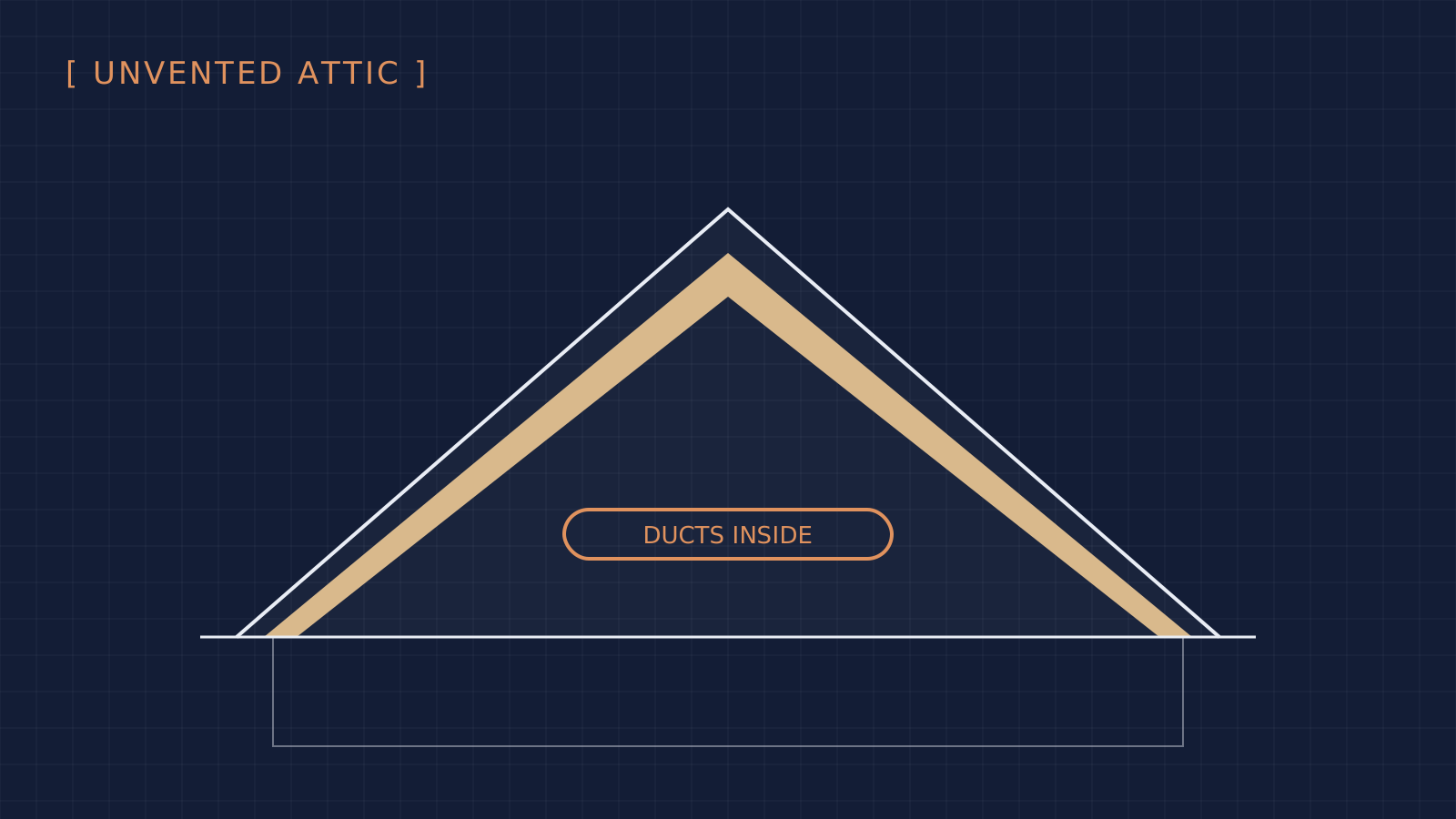
In an unvented attic, the insulation is applied to the underside of the roof deck and the gable walls, and the attic vents are sealed. The envelope moves up to the roofline. The attic becomes part of the inside of the house, sitting much closer to indoor conditions than outdoor ones.
| Feature | Vented attic | Unvented attic |
|---|---|---|
| Insulation location | Attic floor | Underside of roof deck & gables |
| Attic vents | Open to outside air | Sealed |
| Attic conditions | Close to outdoor conditions | Close to indoor conditions |
| Ducts & equipment | Outside the envelope | Inside the envelope |
| Air sealing focus | Ceiling plane and every penetration | Roofline |
Why the ducts are the real story
If an attic held nothing but framing, a vented attic with a well-sealed ceiling would usually be the simpler choice. The trouble is that many attics also hold the air handler and a network of ducts. In a vented attic, that equipment sits in the harshest conditions in the house. Cooled air travels through ducts surrounded by summer attic heat, heated air through ducts surrounded by winter cold, and any leak at a joint or boot dumps conditioned air outdoors.
Put the insulation at the roof deck and all of that changes. The ducts now run through a space that's close to indoor temperature, so they lose far less energy along the way, and a leaky joint leaks into the house instead of outside it. In humid climates there's a second benefit: cold supply ducts in a hot, humid vented attic can collect condensation, and bringing them inside the envelope takes away the warm, moist air that causes it.
An unvented attic also changes the air-sealing job. Instead of chasing every light fixture, top plate and bath fan penetration in the ceiling, the air seal goes across the roofline, where spray foam can cover the whole surface in one continuous layer. For more on why air sealing matters so much, see why air sealing matters for energy bills.
What the code and the evaluation report say
Unvented attics are recognized in the International Residential Code. IRC Section R806.5 (numbered R806.4 in older editions) covers unvented attic and unvented enclosed rafter assemblies, and it sets conditions that depend on the climate zone and the type of insulation used. Those conditions matter, so the design should be checked against the code edition your jurisdiction has adopted.
For ComfortSeal HFO, IAPMO evaluation report ER-975 recognizes installation in unvented attics in accordance with IRC Section R806.5. Its no-coating path (Section 4.5.2.2) applies only when all of these hold: the attic is entered only to service utilities and nothing is stored there; it is not interconnected with other attic or crawl space areas; air from the attic is not circulated to other parts of the house; attic ventilation is provided where the code requires it, or the unvented attic complies with R806.5; the foam stays within 10 inches on the roof deck and 6 inches on walls; and combustion air is provided per the mechanical code. Miss one and a prescriptive ignition barrier is required instead.
For ComfortSeal 500, ER-974 Section 3.3.4.1 says the foam may be installed in unvented attics in accordance with IRC Section R806.4 (the same provision, numbered R806.5 in newer editions), with an ignition barrier, either prescriptive or one of the Table 5 coatings. Either way, bring the report to the permit conversation — both are in our Tech Library.
Open cell or closed cell at the roof deck?
Both foams are used at rooflines, and the right choice depends on the climate, the rafter depth and what the roof assembly needs from the insulation.
ComfortSeal HFO closed cell brings more R-value in the same depth than open cell, which matters when rafters are shallow. ER-975 lists R-39 at 5.5 inches and R-51 at 7.25 inches. At 2 inches it rates 0.45 perms, a Class II vapor retarder, so the foam itself controls vapor at the deck. It has been tested for wind uplift resistance at 210 psf under UL 1897, and it requires no ignition barrier coating in service-only attics, up to 10 inches on the roof deck (ICC-ES AC377 Appendix X, ER-975).
ComfortSeal 500 open cell fills deep rafter bays efficiently at a lower cost per inch, and its expansion — roughly 100 times its liquid volume — seals the roofline thoroughly. ER-974 lists R-27 at 7.5 inches and R-34 at 9.5 inches. It's vapor-open at 21 perms at 1 inch, which lets the assembly dry toward the interior; in colder climate zones, code conditions for vapor control come into play, so check R806.5 for your zone. In attics, its data sheet shows an AC377 Appendix X pass with DC315 at 6 wet / 4 dry mils or No-Burn Plus ThB at 4 wet / 3 dry mils.
For the full picture on thickness, see spray foam R-value by thickness; for coatings, see ignition barrier vs. thermal barrier.
Humid-climate considerations
On the Gulf Coast and in other humid regions, moisture is as important as heat. A few things to plan for:
- Size the HVAC for the new envelope. Once the attic is inside, the house has a different load and a different volume of conditioned air. Bring your HVAC contractor into the conversation early.
- Think about humidity inside the attic. A sealed attic is part of the house, so it needs to be accounted for in how the home's humidity is managed. Your HVAC designer can advise on the approach.
- Consider closed cell's vapor control. ComfortSeal HFO's Class II vapor retarder rating is one reason it's popular in hot, humid climates. Our guide to spray foam in humid coastal climates goes deeper.
- Start with a sound roof. Foam isn't a fix for roof leaks. Repair the roof before insulating the deck, and know that a leak in a foam-insulated roof may show up differently than it would in a vented attic.
Managing attic humidity deserves its own line. A sealed attic that gets no conditioned air can drift warmer and more humid than the rooms below, so designers commonly give it a small supply-air register, a transfer path back to the house, or dedicated dehumidification. If open cell foam goes at the deck in a humid zone, IRC R806.5 sets the vapor-diffusion and climate-zone conditions for air-permeable insulation, so that part of the design has to satisfy R806.5 rather than rely on the foam alone. Have the HVAC designer size the approach with the rest of the system.
When an unvented attic makes sense — and when it doesn't
It's usually worth a serious look when:
- HVAC equipment or ductwork runs through the attic.
- The ceiling below is hard to air seal: lots of recessed lights, complex framing, knee walls or bonus rooms.
- The roof has a complicated shape with valleys, hips and dormers that make venting difficult.
- The owner wants equipment in the attic to be easier and more comfortable to service.
A vented attic may be the simpler choice when:
- There are no ducts or equipment in the attic and the ceiling is simple and easy to seal.
- The roof needs replacing soon and the work can't be sequenced before insulating.
- Local code conditions for your climate zone make the unvented assembly impractical.
An unvented attic moves the envelope to the roofline so the ducts and equipment live indoors. Choose the foam for the climate and rafter depth, build to IRC R806.5 and the evaluation report, and confirm the design with your building official.
Builders and architects can talk through an assembly with our team, and homeowners can find a certified ComfortSeal installer to evaluate their attic.
Frequently asked questions
What is an unvented attic?
An attic where insulation is applied to the underside of the roof deck and gable walls and the vents are sealed, moving the thermal envelope from the ceiling up to the roofline. The attic then sits close to indoor conditions, and any HVAC equipment or ductwork in it is inside the conditioned space.
Why put spray foam on the roof deck instead of the attic floor?
Usually because of the ducts. In a vented attic, ducts and air handlers sit in the harshest conditions in the house and any leak dumps conditioned air outdoors. At the roof deck, the foam brings them inside the envelope, and the air seal runs across one continuous surface instead of every ceiling penetration.
Open cell or closed cell at the roof deck?
Both are used. ComfortSeal HFO closed cell gives more R-value in shallow rafters (R-39 at 5.5 inches, ER-975), is a Class II vapor retarder at 2 inches and needs no ignition barrier coating in service-only attics within ER-975 limits. ComfortSeal 500 open cell fills deep bays (R-34 at 9.5 inches, ER-974) but needs an ignition barrier, and R806.5 sets vapor-control conditions by climate zone.
Does an unvented attic need its own conditioning?
Often, yes. A sealed attic that gets no conditioned air can drift warmer and more humid than the rooms below, so designers commonly give it a small supply register, a transfer path back to the house or dedicated dehumidification. Bring the HVAC designer in early, because the envelope and load have changed.