
Spray foam insulation products
Open cell or closed cell — pick by the assembly.
Two foams, each with its own IAPMO evaluation report: ComfortSeal 500 open cell for interior walls, attics and sound control, and ComfortSeal HFO closed cell for exterior walls, crawl spaces and unvented attics. Specs, barrier requirements and a side-by-side are below.
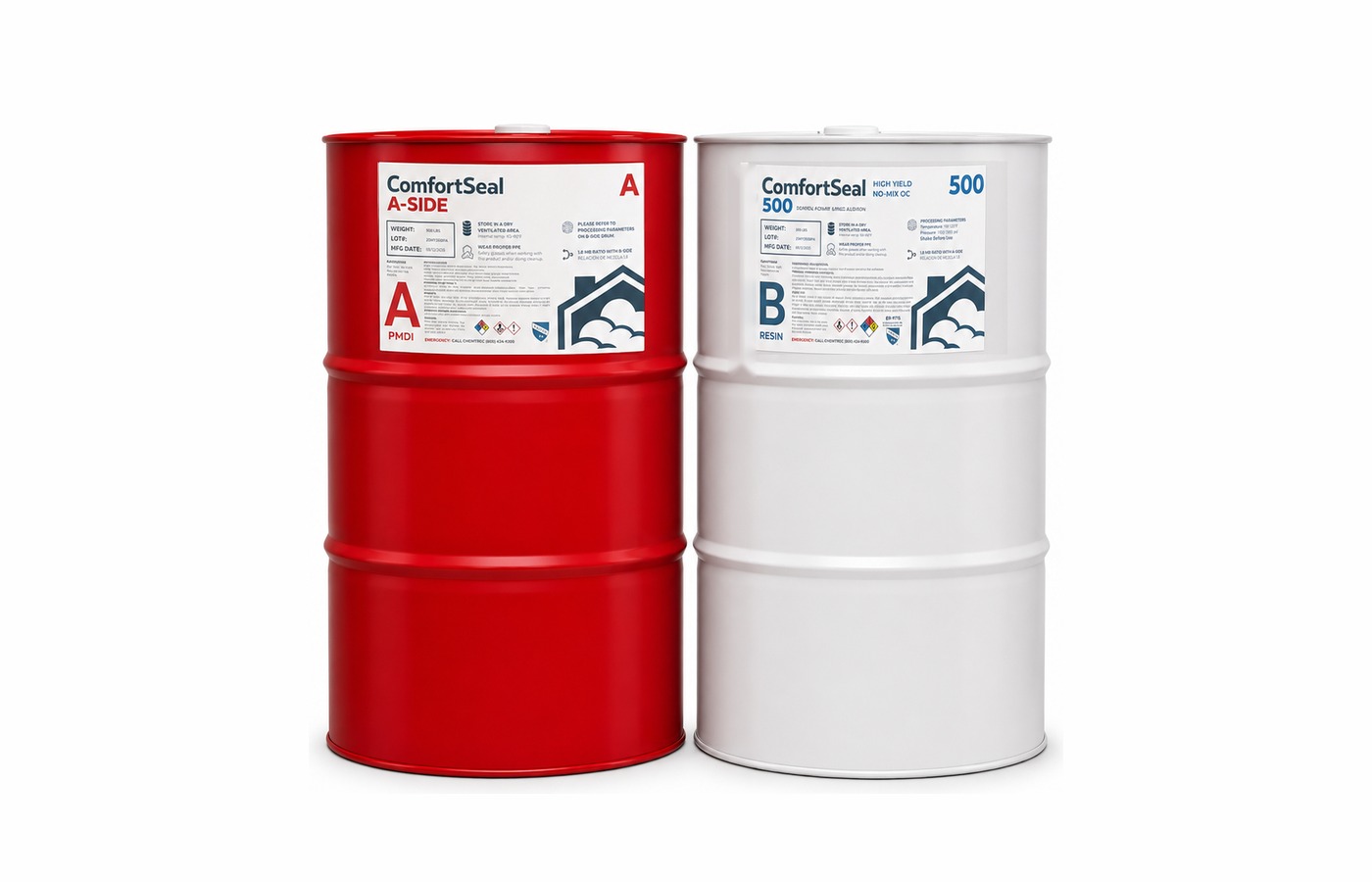
ComfortSeal 500
The air-sealing, sound-dampening workhorse for interior walls, attics, and bonus rooms. Expands roughly 100× on contact to fill the cavity around wiring, outlets and framing — for a quieter, more comfortable house.
Best for
Specifications
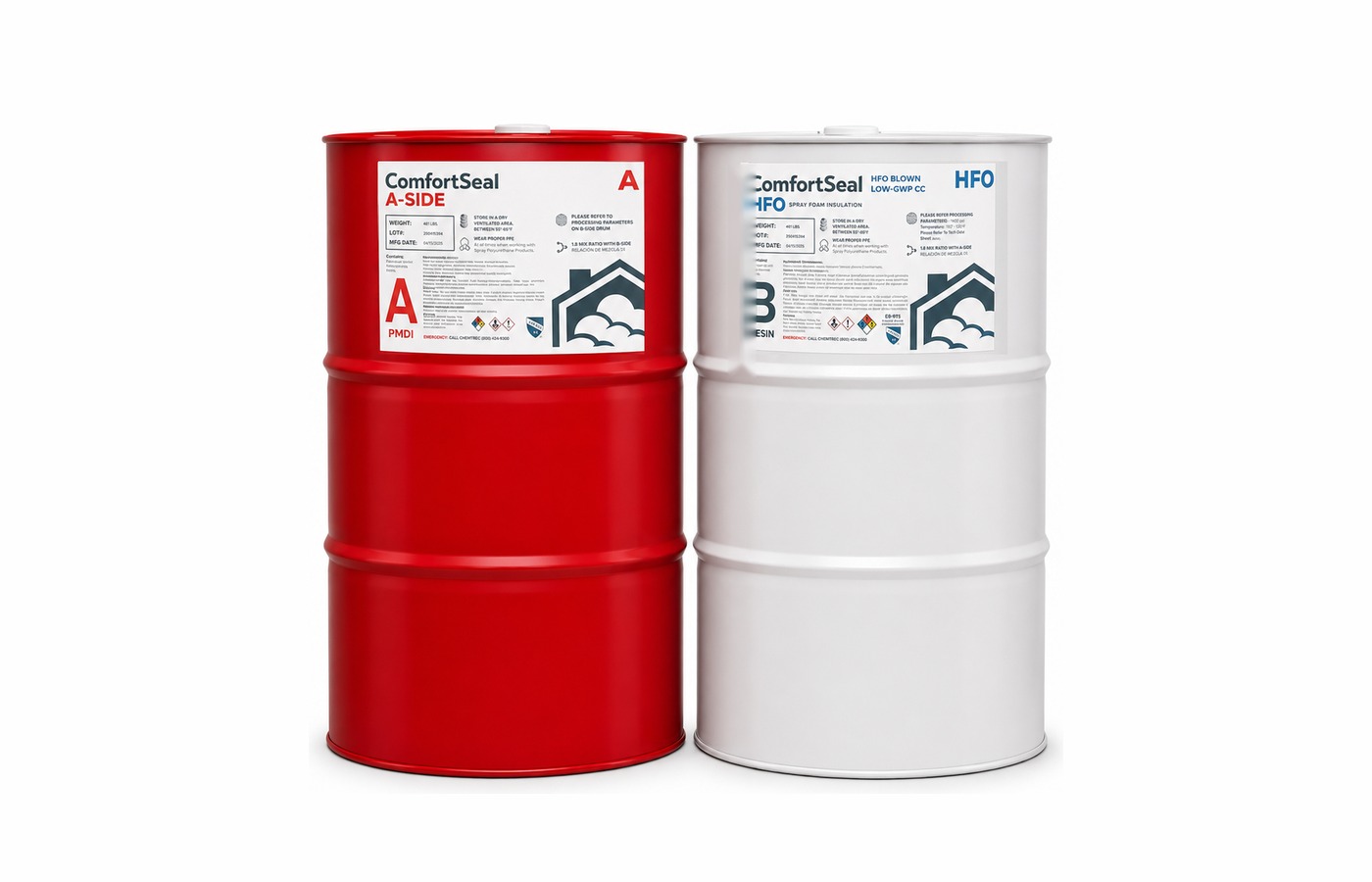
ComfortSeal HFO
The higher R-value at any given thickness in the ComfortSeal line, with vapor control and a 210 psf wind uplift rating as tested (UL 1897). Cures rigid. HFO blown with a global warming potential of 1, a small fraction of the older HFC blowing agents.
Best for
Specifications
Which product for which job?
| ComfortSeal 500 · Open Cell | ComfortSeal HFO · Closed Cell | |
|---|---|---|
| R-value at 3.5 in. (2x4) | R-13 | R-25 |
| R-value at 5.5 in. (2x6) | R-20 | R-39 |
| Vapor retarder | No — vapor open (21 perms at 1 in.) | Class II — 0.45 perms at 2 in. |
| Sound dampening | NRC 0.75 · STC 39 | Not published |
| Typical use | Interior walls, attics, sound control | Exterior walls · Crawl spaces · Unvented attics · Rim joists |
The higher the R-value, the greater the insulating power. Ask your seller for the fact sheet on R-values.
Density, blowing agent, cured-foam properties and the barrier rules for each are on the product pages. Full comparison: open cell vs. closed cell spray foam
Which foam goes where
A starting point for each part of the house. The final choice depends on climate zone, local code and the assembly, so confirm it against the evaluation report and with your building official.
Attic rooflines
Both are recognized for unvented attics. ComfortSeal 500 (where the climate allows, ER-974 §3.3.4.1) needs an ignition barrier in service-only attics; ComfortSeal HFO needs no coating there, up to 10 inches on the roof deck, within ER-975's service-only conditions.
Interior walls & sound control
Open cell absorbs sound (NRC 0.75, STC 39) and stays vapor-open, which suits partitions, media rooms and floors between levels.
Exterior walls
More R-value in a shallow cavity (R-25 at 3.5 inches per ER-975) and a Class II vapor retarder at 2 inches.
Crawl spaces
Low water absorption (1.44%) and no fungal growth under ASTM G21. No coating in service-only crawl spaces up to 6 inches on walls. It must not be in contact with soil or water.
Rim joists
Seals the band where the house meets the foundation and cures into a rigid, bonded layer, applied in passes of up to 3 inches.
Humid climates & high-wind zones
A Class II vapor retarder at 2 inches and 210 psf wind uplift as tested (UL 1897). Many homes pair it with ComfortSeal 500 on the interior.
Find your foam in 30 seconds
Where is the foam going?
Your result
What installers and specifiers ask
What's the difference between ComfortSeal 500 and ComfortSeal HFO?+
ComfortSeal 500 is a 0.5 lb open cell foam: R-13 at 3.5 inches, vapor-open (21 perms at 1 inch) and sound-absorbing (NRC 0.75). ComfortSeal HFO is a 2.0 lb closed cell foam: R-25 at 3.5 inches, a Class II vapor retarder at 2 inches, and rigid once cured.
What R-value do I get at a given thickness?+
Use the tables in the evaluation reports, because spray foam R-value doesn't rise in a straight line with thickness. ER-974 lists ComfortSeal 500 at R-13 at 3.5 inches and R-20 at 5.5 inches. ER-975 lists ComfortSeal HFO at R-25 at 3.5 inches and R-39 at 5.5 inches. The R-value calculator reads both tables.
Do the foams need an ignition barrier or a thermal barrier?+
In living areas, both need a thermal barrier such as ½-inch drywall, or an approved coating: DC315 at 18 wet / 12 dry mils over ComfortSeal 500, or DC315 or No-Burn Plus ThB at 14 wet / 9 dry mils over ComfortSeal HFO. In attics and crawl spaces entered only for service, ComfortSeal 500 needs an ignition barrier, such as DC315 at 6 wet / 4 dry mils or No-Burn Plus ThB at 4 wet / 3 dry mils. ComfortSeal HFO needs no coating there, provided the space is entered only to service utilities, has no storage, isn't interconnected and doesn't circulate air to the house, up to 10 inches on the roof deck and 6 inches on walls (ER-975 Section 4.5.2.2); the space still needs a thermal barrier to living areas. Each coating carries a maximum foam thickness in its report table.
Does either foam act as a vapor retarder?+
ComfortSeal HFO measures 0.45 perms at 2 inches and qualifies as a Class II vapor retarder under IRC R202. ComfortSeal 500 is vapor-open at 21 perms at 1 inch, so where the code calls for a vapor retarder, one is installed with it (ER-974 Section 2.5).
How thick can each foam be sprayed in one pass?+
Up to 6 inches per pass for ComfortSeal 500 and up to 3 inches per pass for ComfortSeal HFO, building up to the full thickness in multiple passes as the evaluation reports describe.
Who can install ComfortSeal, and where is it recognized?+
Both IAPMO evaluation reports require installation by contractors certified by USAFoam, LLC (ER-974 Section 2.2, ER-975 Section 2.5), and recognize both foams as nonstructural thermal insulation in Type V construction under the IBC and in one- and two-family dwellings under the IRC. Contractors can ask about certification; homeowners can request a certified installer.
Full documentation for every job
Technical data sheets and evaluation reports (ER-974, ER-975) are available in the tech library — everything your inspector or builder needs.