
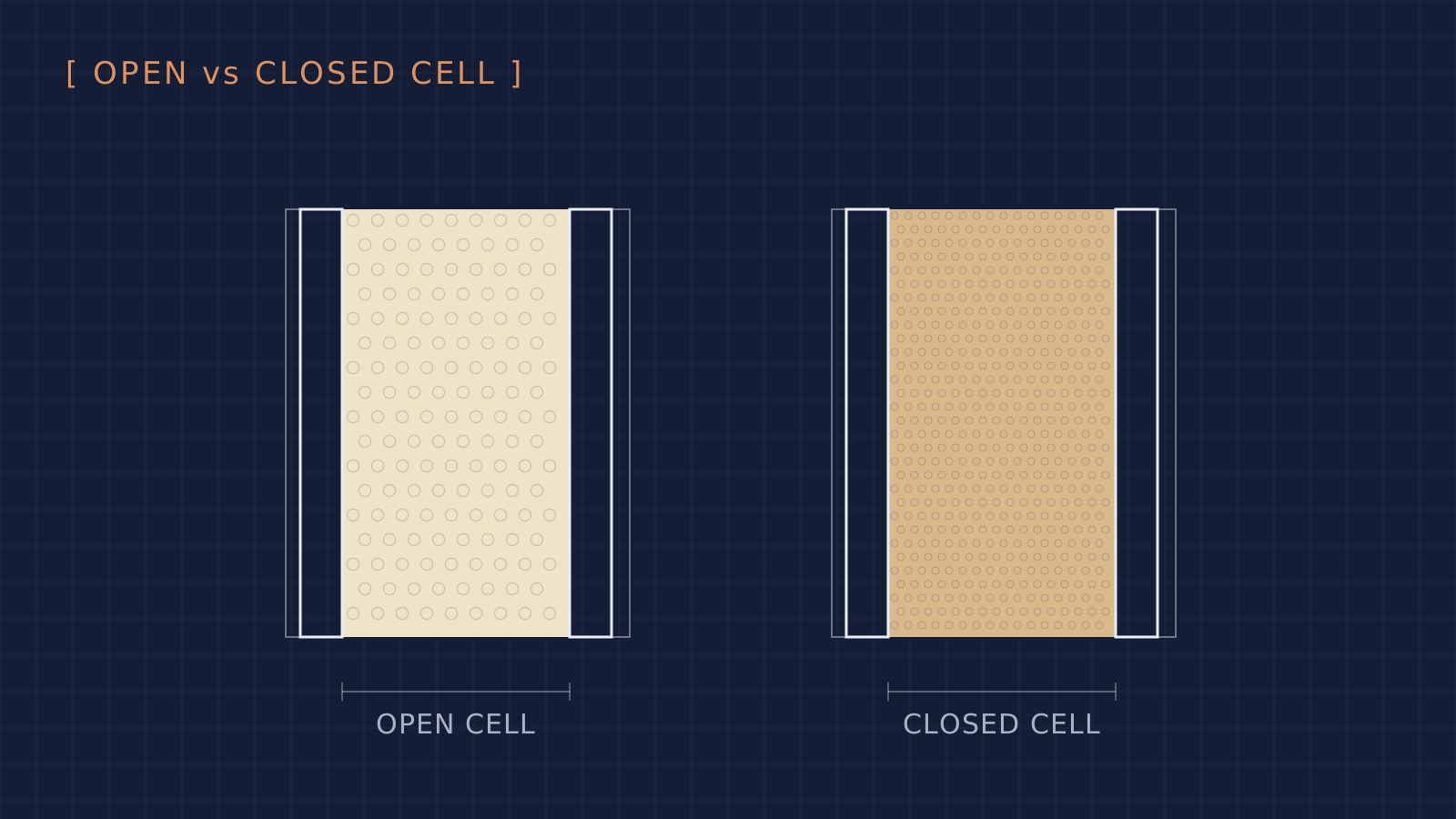
Every spray foam pro gets the question — from a homeowner at the kitchen table, from a builder comparing bids, from a new crew member on their first job: open cell or closed cell? The honest answer is that neither foam is "better." They're two different tools, and the pros who bid confidently are the ones who can explain, in plain language, which tool each assembly calls for.
Here's the decision framework we teach in ComfortSeal certification, using the two products in our lineup: ComfortSeal 500 open cell and ComfortSeal HFO closed cell.
What open cell foam actually is
Open cell foam is the light one — ComfortSeal 500 cures at just 0.5 lb/ft³. It's water blown, and on contact it expands roughly 100 times its liquid volume, surging into cavities and sealing around wiring, plumbing, and framing irregularities that batts simply can't follow. That expansion is the point: the result is a continuous airtight seal across the whole assembly.
The open cell structure that keeps it light also makes it a genuinely good acoustic material. ComfortSeal 500 carries an NRC of 0.75 and an STC rating of 39 — real sound control between bedrooms, around media rooms, and under bonus-room floors. It delivers R-13 in a 2x4 wall (3.5 inches), carries a Class I flame spread and smoke index (ASTM E84), and is documented under evaluation report ER-974 for inspectors.
What closed cell foam actually is
Closed cell is the dense one — ComfortSeal HFO cures at 2.0 lb/ft³, four times the density of open cell. That density buys three things open cell can't offer.
First, R-value in the same depth: at R-25 in a 3.5-inch (2x4) cavity, against R-13 for open cell, ComfortSeal HFO packs more thermal resistance into a framing cavity — the answer when a 2x4 wall needs to perform like a much thicker one.
Second, moisture control: at 2 inches, ComfortSeal HFO rates 0.45 perms, making the insulation itself a Class II vapor retarder. In humid and coastal climates, that's often the deciding factor.
Third, durability and resilience: ComfortSeal HFO is wind uplift rated to 210 psf (UL 1897), shows no fungal growth under ASTM G21 testing, and requires no ignition barrier coating in service-only attics and crawl spaces (ICC-ES AC377 Appendix X, within ER-975's thickness limits). It's blown with an HFO blowing agent with a global warming potential of 1, and it's documented under evaluation report ER-975.
Side by side: the numbers pros quote
| Property | ComfortSeal 500 (open cell) | ComfortSeal HFO (closed cell) |
|---|---|---|
| Density | 0.5 lb/ft³ | 2.0 lb/ft³ |
| R-value at 3.5 in. (2x4) | R-13 | R-25 |
| R-value at 5.5 in. (2x6) | R-20 | R-39 |
| Blowing agent | Water blown | HFO (GWP of 1) |
| Expansion | ~100× on contact | ~15× (controlled, dense lift) |
| Vapor permeance (ASTM E96) | Vapor-open: 21 perms at 1 in. | 0.45 perms at 2 in. — Class II vapor retarder |
| Sound control | NRC 0.75 · STC 39 | — |
| Surface burning (ASTM E84) | Class I flame spread & smoke | Class I flame spread & smoke |
| Barrier path | Attics & crawl spaces: prescriptive ignition barrier or ER-974 Table 5 coating (DC315 6 wet / 4 dry mils, or No-Burn Plus ThB 4 wet / 3 dry mils). Living space: ½-in. gypsum or DC315 18 wet / 12 dry mils (Table 4) | Service-only attics & crawl spaces: no ignition barrier coating within ER-975 §4.5.2.2 limits (≤10 in. roof deck / ≤6 in. walls). Living space: prescriptive thermal barrier, or DC315 or No-Burn Plus ThB at 14 wet / 9 dry mils (Table 2) |
| Max thickness per pass | 6 in. (ER-974) | 3 in. (ER-975) |
| Resilience | — | 210 psf wind uplift (UL 1897) · no fungal growth (ASTM G21) |
| Evaluation report | ER-974 | ER-975 |
| Typical placements | Interior partitions, attic roof decks where IRC R806.5 allows air-permeable insulation, media rooms and anywhere sound control matters | Exterior walls, crawl space walls, rim joists, roof decks in humid climates, storm zones, shallow cavities that need more R-value |
| Relative cost tier | Lower per board foot (less material per inch) | Higher per board foot (more material per inch, more R-value per cavity) |
Sources: IAPMO UES ER-974 and ER-975 (Table 1 R-values, coating tables, per-pass limits); ComfortSeal data sheets (ASTM E84, ASTM E96, ASTM C423, ASTM E413, UL 1897, ASTM G21). Cost tiers are relative; installers quote their own prices.
Matching the foam to the assembly
Reach for ComfortSeal 500 open cell when:
- You're insulating interior partition walls and want sound control between rooms.
- You're sealing a vented attic, or an unvented one where IRC R806.5 allows air-permeable insulation at the roof deck for the climate zone (a humid-climate caveat: check the vapor-control conditions for your zone), and cavity depth is generous.
- The budget conversation matters — open cell fills big volumes efficiently, and its 100× expansion follows air leaks into irregular framing.
Reach for ComfortSeal HFO closed cell when:
- You're on an exterior wall and need the most R-value the cavity depth allows (R-25 at 3.5 in., ER-975).
- The project sits in a humid or coastal climate where a vapor retarder belongs in the assembly.
- You're building in a storm zone and the 210 psf wind uplift rating and moisture resilience earn their keep.
Climate note. Open cell is common in interior partitions and at attic roof decks, where IRC R806.5 sets the conditions for air-permeable insulation by climate zone. Closed cell is the usual pick wherever the assembly needs a Class II vapor retarder — crawl space walls, rim joists and exterior walls in humid climates — because ComfortSeal HFO provides one at 2 inches (0.45 perms, ER-975). Which zones call for which is a code and design question, so check the code your jurisdiction has adopted rather than assuming.
Open cell is the air-sealing and sound-control workhorse for the inside of the house. Closed cell is the high-R, moisture-controlling layer for the parts of the house that face the weather.
The pro move: both foams, one house
Many of the homes we see aren't open cell houses or closed cell houses — they're both. A common Gulf Coast spec: ComfortSeal HFO on the exterior walls, where R-25 in a 2x4 wall and the built-in vapor retarder handle heat and humidity, and ComfortSeal 500 in the attic and interior partitions, where its expansion seals the envelope and its acoustic ratings quiet the house.
Either way, the fundamentals hold: spray foam creates a continuous airtight seal, and that seal, more than any per-inch R-value, is where spray foam separates itself from batts and blown insulation. Savings vary with the house and climate. Installs by certified ComfortSeal installers carry a limited lifetime warranty on the foam, for the life of the home; installation workmanship is the installing contractor's responsibility.
A two-product lineup is deliberate. Your crews master both materials fast, you carry less inventory, and every residential assembly has a clear answer. When a homeowner asks "open or closed?", you're not guessing — you're walking them through a framework.
Frequently asked questions
What is the difference between open cell and closed cell spray foam?
Density and cell structure. ComfortSeal 500 open cell cures at 0.5 lb/ft³, is water-blown, expands roughly 100 times and stays vapor-open. ComfortSeal HFO closed cell cures at 2.0 lb/ft³, expands roughly 15 times, and at 2 inches is a Class II vapor retarder at 0.45 perms. In a 3.5-inch cavity, open cell is R-13 and closed cell is R-25 (IAPMO ER-974 and ER-975).
Is closed cell spray foam better than open cell?
Neither is better; they do different jobs. Closed cell delivers more R-value in the same depth and controls vapor, so it suits exterior walls, crawl spaces and rim joists. Open cell fills large volumes efficiently, absorbs sound (NRC 0.75, STC 39) and lets assemblies dry inward, so it suits interior walls and many attic roof decks.
Which spray foam costs more?
Closed cell is the higher cost tier per board foot because it uses more material for each inch installed: ComfortSeal HFO expands roughly 15 times its liquid volume against roughly 100 times for ComfortSeal 500. In exchange it delivers more R-value per cavity and a built-in vapor retarder. Installers quote their own prices; ComfortSeal does not publish them.
Can you use both open cell and closed cell in the same house?
Yes, and many Gulf Coast homes do. A common spec is ComfortSeal HFO on the exterior walls, where R-25 in a 2x4 cavity and the Class II vapor retarder handle heat and humidity, and ComfortSeal 500 in the attic and interior partitions for air sealing and sound control.