
Ask a homeowner what insulation does and you'll hear some version of "it keeps the heat in." Ask them how it's measured and — if they've shopped around at all — they'll say R-value. Then they'll compare two bids by dividing price by R and pick the cheaper one.
Here's what that math misses, and what every contractor selling spray foam should be able to explain in two minutes: air leakage — not just insufficient R-value — is a major cause of energy loss in a home. That single fact is the whole reason spray foam can outperform traditional insulation, and it's the story that wins the bid.
R-value only measures one kind of heat loss
R-value measures resistance to conductive heat flow — heat working its way through a material. It's a real and useful number. But it says nothing about the heat that never bothers going through the insulation at all, because it rides the air around it.
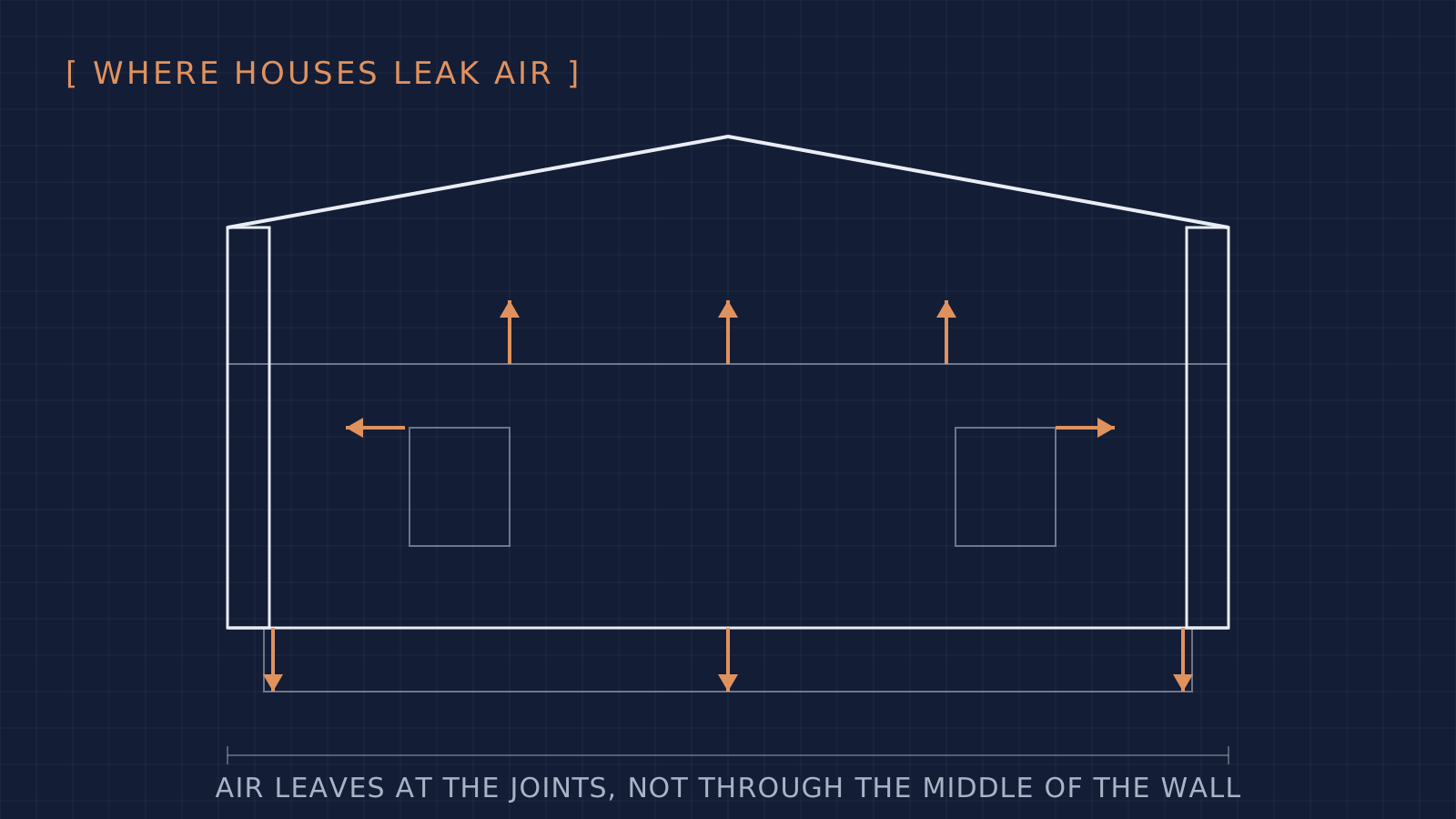
Every home breathes through hundreds of small paths: the gaps where batts don't quite meet the studs, the holes drilled for wiring and plumbing, top plates, band joists, attic penetrations. Conditioned air you paid to cool leaks out; hot, humid outside air gets pulled in to replace it. Your HVAC runs to condition air that's literally leaving the building.
An R-value on a bag measures a material in a lab. It doesn't measure the assembly in a house — and the assembly is what the homeowner pays to heat and cool.
Where traditional insulation falls short
Fiberglass and cellulose insulate, but they don't air seal — and the gap shows up in both the numbers and the workmanship realities:
- Fiberglass delivers roughly R-2.9 to R-3.8 per inch in standard-density batts (U.S. DOE), and batts leave gaps — around wiring, at cut-ins, wherever the fit isn't perfect. Air moves freely through and around it.
- Cellulose ranges from about R-2.9 to R-3.4 per inch as blown-in loose-fill, R-3.0 to R-3.4 dense-packed and R-3.6 to R-3.8 sprayed on, according to the DOE Building America guide Energy Renovations: Insulation (2012). Loose-fill in an attic can settle over time, which is why the same guide has contractors staple depth rulers in place to track it.
Neither material stops air movement. So even a technically "well-insulated" house can leak like a screen door — and the homeowner's utility bill is where that shows up.
What spray foam changes: the continuous envelope
Spray foam does two jobs with one product. It insulates — ComfortSeal 500 open cell at R-13 and ComfortSeal HFO closed cell at R-25 in a 3.5-inch (2x4) wall — and, because it's applied as a liquid that expands in place (open cell expands roughly 100× on contact), it creates a continuous airtight seal across the entire assembly. Around wires. Into corners. Against irregular framing.
That's the difference between installing an insulation product and building an envelope.
Traditional insulation resists heat flow but ignores air flow. Spray foam does both — and because air leakage is a major source of energy loss, sealing it is where spray foam makes its difference. Savings vary by house.
Proof you can point to: blower doors and HERS scores
The good news for pros is that airtightness isn't a hand-wavy claim — it's measured. A blower-door test depressurizes the house and quantifies exactly how leaky it is, and a spray-foamed envelope shows up directly in better blower-door results. For builders, that same tightness improves HERS ratings — the energy scorecard that can be used for code compliance and for marketing a new home.
That gives you a story with receipts: spec spray foam, and the improvement isn't just something the homeowner feels in August — it's a number on a report the builder can put in front of a buyer or a code official.
Talking about savings without overpromising
Spray foam costs more upfront than batts. Don't dodge that, and don't paper over it with a headline percentage either. Savings depend on the house, the climate, how leaky it is today and what the foam replaces, and the FTC's R-value Rule (16 CFR Part 460) requires a reasonable basis for any energy-savings claim you make, along with the plain statement that savings vary. A single "up to" number quoted across every house is exactly what that rule is aimed at.
What works better is the house in front of you: what the homeowner pays to heat and cool it now, what a blower-door test says about its leakage, and the price difference over batts. Add what doesn't change with the house: the R-value by thickness is published in the IAPMO reports, and the warranty is in writing. Installs by certified ComfortSeal installers carry a limited lifetime warranty on the foam, for the life of the home; installation workmanship is the installing contractor's responsibility. That is a story you can stand behind.
Telling the story at the kitchen table
You don't need to lecture anyone on building science. A simple sequence works:
- Start with the pain: "Which rooms are uncomfortable? What do summer power bills look like?"
- Name the real culprit: "A lot of that isn't thin insulation — it's air leaking in and out, and batts don't stop it."
- Show the difference: "Batts filter air; foam seals it. It expands to fill the cavity and seals the seams it's applied to."
- Be straight about the math: "Savings vary by house, so let's look at your bills and your house rather than a brochure number. What I can promise is the R-value on paper, a sealed envelope, and a warranty behind the foam."
Comfort they can feel, numbers on paper, and a warranty behind it. That's a conversation R-value-per-dollar can't win.
Frequently asked questions
Does a higher R-value always mean lower energy bills?
No. R-value measures resistance to conductive heat flow through a material. It says nothing about air leaking around the insulation through gaps, wiring holes, top plates and rim joists. Air leakage is a major cause of energy loss, so a house can be well insulated on paper and still leak.
How does spray foam reduce air leakage?
It is applied as a liquid that expands in place, open cell roughly 100 times on contact, so it fills around wiring, corners and irregular framing and forms a continuous air seal across the assembly while insulating: ComfortSeal 500 at R-13 and ComfortSeal HFO at R-25 in a 3.5-inch wall (IAPMO ER-974 and ER-975).
How can airtightness be measured?
A blower-door test depressurizes the house and quantifies how leaky it is, so a spray-foamed envelope shows up directly in the result. For new homes, the same tightness feeds into a HERS rating, an energy scorecard that can be used for code compliance and for marketing a home to buyers.
Can a contractor promise a specific energy savings percentage?
Not responsibly. Savings depend on the house, climate, current leakage and what the foam replaces. The FTC R-value Rule (16 CFR Part 460) requires a reasonable basis for any energy-savings claim and the plain statement that savings vary. Talk about the homeowner's bills and blower-door results instead of a brochure number.