
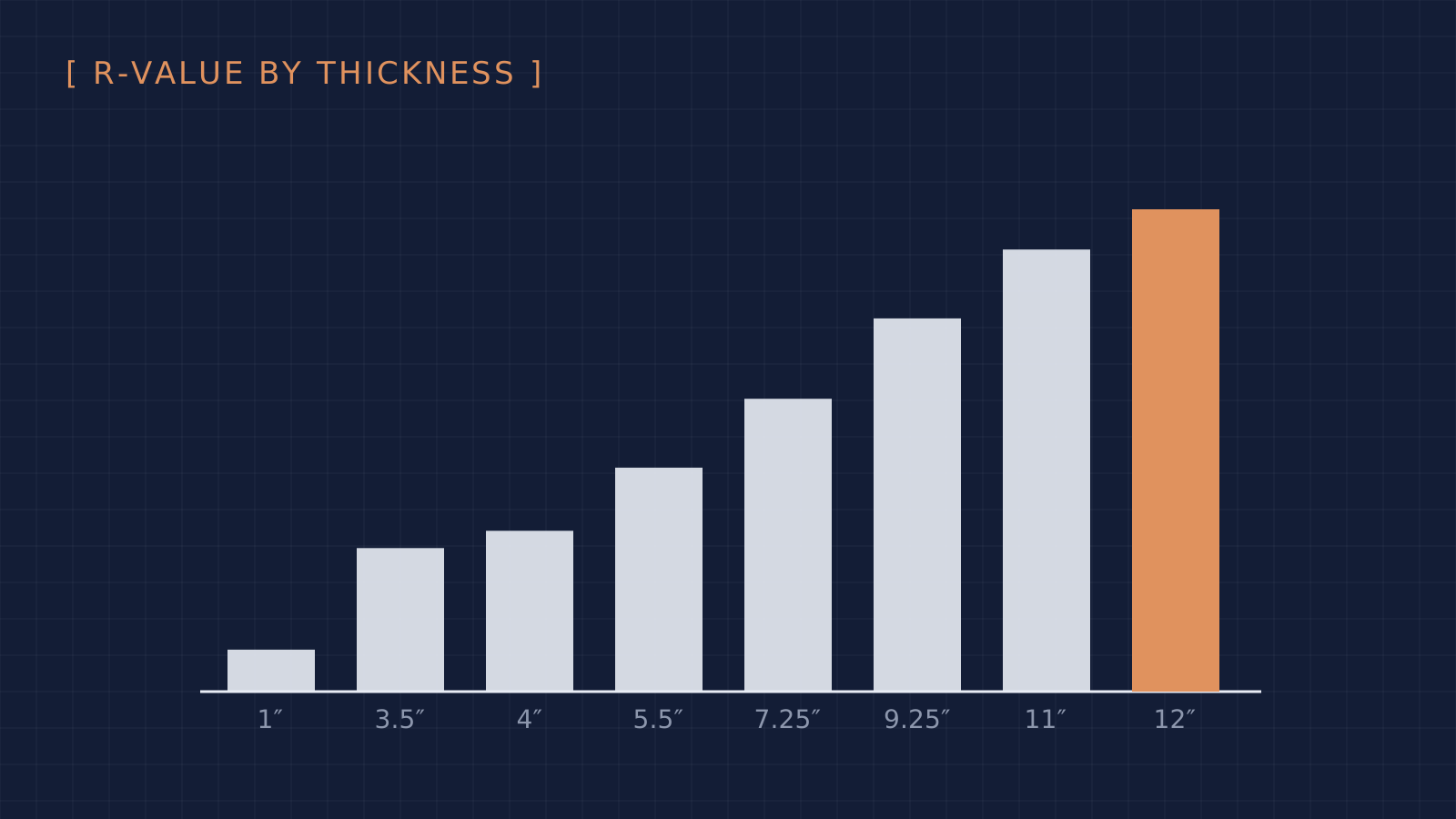
Ask ten estimators what R-value a 5.5-inch fill of closed cell foam delivers and a few of them will reach for a calculator: R-value per inch times inches. It's a fast habit, and it's the wrong one. The number that belongs on a spec sheet, an insulation certificate or a bid isn't the result of multiplication. It's the number published in the product's evaluation report.
For ComfortSeal, those reports are IAPMO UES ER-974 for ComfortSeal 500 open cell and ER-975 for ComfortSeal HFO closed cell. Each one carries a Table 1 that lists R-values at specific installed thicknesses. Here's what those tables say, why they don't follow a straight line, and how to use them when you're matching foam to a framing cavity.
R-value per inch is a starting point, not a spec
Both ComfortSeal data sheets lead with an R-value measured on a 1-inch specimen under ASTM C518, and the evaluation reports show that the per-inch figure falls as the foam gets thicker. ComfortSeal 500 gives R-4.1 per inch at 1 inch, falling to R-3.5 to R-3.7 per inch from 3.5 to 14 inches. ComfortSeal HFO gives R-7.3 per inch at 1 inch, falling to R-7.0 to R-7.1 per inch from 3.5 to 12 inches. The R-value per inch of this insulation varies with thickness. The thicker the insulation, the lower the R-value per inch. The higher the R-value, the greater the insulating power. Ask your seller for the fact sheet on R-values.
Per-inch figures are useful for one thing — comparing materials at a glance. They tell you closed cell packs more thermal resistance into each inch than open cell, which is why it's the go-to when cavity depth is tight.
What a 1-inch figure can't tell you is what a thicker layer delivers. The IAPMO tables answer that question directly. According to the reports, the ComfortSeal 500 values are calculated from k-factors tested at 1 inch and 3.5 inches, and the ComfortSeal HFO values are calculated from k-values tested at 1 inch and 4 inches. Both are reported at a 75°F mean temperature, the standard condition insulation R-values are compared at. In other words, the thicker rows are calculated from tests at two thicknesses (Table 1 footnotes); they are not measured separately at each depth, and they are not an extrapolation from the 1-inch number alone.
ComfortSeal 500 open cell: ER-974 Table 1
These are the R-values IAPMO ER-974 lists for ComfortSeal 500, exactly as published.
| Installed thickness | R-value (ER-974) |
|---|---|
| 1.0 in | R-4.1 |
| 3.5 in | R-13 |
| 4.0 in | R-14 |
| 5.5 in | R-20 |
| 7.5 in | R-27 |
| 9.5 in | R-34 |
| 11.5 in | R-42 |
| 14 in | R-51 |
ComfortSeal HFO closed cell: ER-975 Table 1
And these are the R-values IAPMO ER-975 lists for ComfortSeal HFO.
| Installed thickness | R-value (ER-975) |
|---|---|
| 1 in | R-7.3 |
| 3.5 in | R-25 |
| 4 in | R-28 |
| 5.5 in | R-39 |
| 7.25 in | R-51 |
| 9.25 in | R-65 |
| 11 in | R-77 |
| 12 in | R-84 |
Notice that the two tables don't use the same thickness steps. Each report lists its own set of rows, so read the table for the product you're actually installing rather than assuming a row exists at every depth.
Why the tables aren't a straight line
Run your finger down either table and compare it with the 1-inch figure. Multiply ComfortSeal 500's 1-inch R-value by 3.5 inches and you get about R-14.4, higher than the R-13 that ER-974 lists. Do the same for ComfortSeal HFO at 5.5 inches and you land at about R-40, above the R-39 that ER-975 lists. The same pattern holds all the way down both tables, and the gap generally grows as the foam gets thicker.
That's the whole point of testing at two thicknesses. The thicker test specimen doesn't return the same per-inch figure as the 1-inch specimen, so the reports build their tables from both measurements instead of assuming every inch performs like the first one. Past the first row, the published values are whole numbers, so quote them exactly as they appear instead of adding decimals of your own.
Multiplying R-value per inch by thickness overstates the result, and the error grows with depth. Quote the table row for the thickness you install — never a number you worked out on a calculator.
Matching thickness to cavity depth
Framing sets the practical limits. A 2x4 wall cavity is 3.5 inches deep and a 2x6 cavity is 5.5 inches deep, and conveniently, both reports publish a row at each of those depths.
| Cavity | ComfortSeal 500 (ER-974) | ComfortSeal HFO (ER-975) |
|---|---|---|
| 2x4 wall, 3.5 in | R-13 | R-25 |
| 2x6 wall, 5.5 in | R-20 | R-39 |
A few practical points follow from that:
- Closed cell doesn't have to fill the cavity to hit a target. ComfortSeal HFO at 3.5 inches is listed at R-25, so in a 2x6 wall the table — not the stud depth — tells you what a partial fill delivers.
- Open cell is usually about filling the depth. ComfortSeal 500's value is in air sealing and volume, so the full-cavity rows (R-13 at 3.5 inches, R-20 at 5.5 inches) are the ones you'll quote most in walls.
- Deep rafters are where the thicker rows matter. At a roof deck, ER-974 lists R-27 at 7.5 inches and R-34 at 9.5 inches for ComfortSeal 500, while ER-975 lists R-51 at 7.25 inches for ComfortSeal HFO. If you're working on an unvented roof assembly, read our guide to unvented attics with spray foam.
- The table covers the foam, not the whole wall. Studs, plates and headers conduct heat around the insulation, so whole-assembly performance is a separate calculation from the foam's R-value.
The deep rows are reached in passes, not one lift: ER-974 limits ComfortSeal 500 to 6 inches per pass and ER-975 limits ComfortSeal HFO to 3 inches per pass, with cure time between passes per the installation instructions. The ASTM E84 surface-burning result for both foams was tested at up to 4 inches, so at greater depths the thermal barrier or ignition barrier path in the evaluation report governs any foam that will be left exposed, with its own maximum thicknesses. See ignition barrier vs. thermal barrier.
Not sure which foam fits which assembly in the first place? Start with open cell vs. closed cell, then come back to the tables to set thickness.
Why published tables beat back-of-envelope math
Using the evaluation report instead of your own arithmetic isn't just about being a few R-points more accurate. It protects the job in ways that matter to everyone on it.
- It's what the inspector checks against. An evaluation report exists so a building official can verify a product's properties. If your paperwork matches ER-974 or ER-975, there's nothing to argue about.
- It keeps bids honest. A competitor who multiplies will quote higher R-values than the report supports. Quoting the table means the number you promise is the number you can document.
- It keeps architects and builders out of trouble. Energy models and specifications built on overstated R-values can fall apart at plan review. Architects and builders should pull the report value straight into the spec.
- It gives crews a clear target. Installers can measure installed depth and match it to a published row, rather than chasing a figure that was never tested.
How to use the tables on your next job
- Pick the product for the assembly first: ComfortSeal 500 or ComfortSeal HFO.
- Find the thickness row that matches what you'll actually install, in that product's report.
- Quote the R-value exactly as listed, and cite the report (ER-974 or ER-975).
- If the thickness you need isn't a listed row, don't multiply your way to an answer — check the full report and confirm with your building official.
- Verify installed depth on site so the certificate matches the foam in the wall.
Every data sheet and evaluation report is in our Tech Library. If you want a second set of eyes on a spec, our team is happy to help — get in touch. And if you're a contractor who wants to understand every row of the data sheet, not just R-value, read how to read a spray foam technical data sheet.
Frequently asked questions
What R-value does spray foam give in a 2x4 wall?
At 3.5 inches, IAPMO ER-974 lists ComfortSeal 500 open cell at R-13 and ER-975 lists ComfortSeal HFO closed cell at R-25. In a 5.5-inch 2x6 cavity the reports list R-20 and R-39. Quote the table row for the installed thickness, not a per-inch figure multiplied out.
Why can't you multiply R-value per inch by thickness?
Because the per-inch value falls as the foam gets thicker. The R-value per inch of this insulation varies with thickness. The thicker the insulation, the lower the R-value per inch. The higher the R-value, the greater the insulating power. Ask your seller for the fact sheet on R-values. The IAPMO tables are calculated from tests at two thicknesses, so multiplying the 1-inch figure overstates the result, and the gap grows with depth.
How thick can spray foam be applied in one pass?
ER-974 limits ComfortSeal 500 to 6 inches per pass and ER-975 limits ComfortSeal HFO to 3 inches per pass, with cure time between passes per the installation instructions. Deep rafter fills such as R-51 at 7.25 inches (HFO) or R-34 at 9.5 inches (500) are built up in passes.
Does the table R-value cover the whole wall?
No. The evaluation report tables cover the foam only. Studs, plates and headers conduct heat around the insulation, so whole-assembly performance is a separate calculation. Energy models and specifications should use the report value for the foam and account for framing separately.