
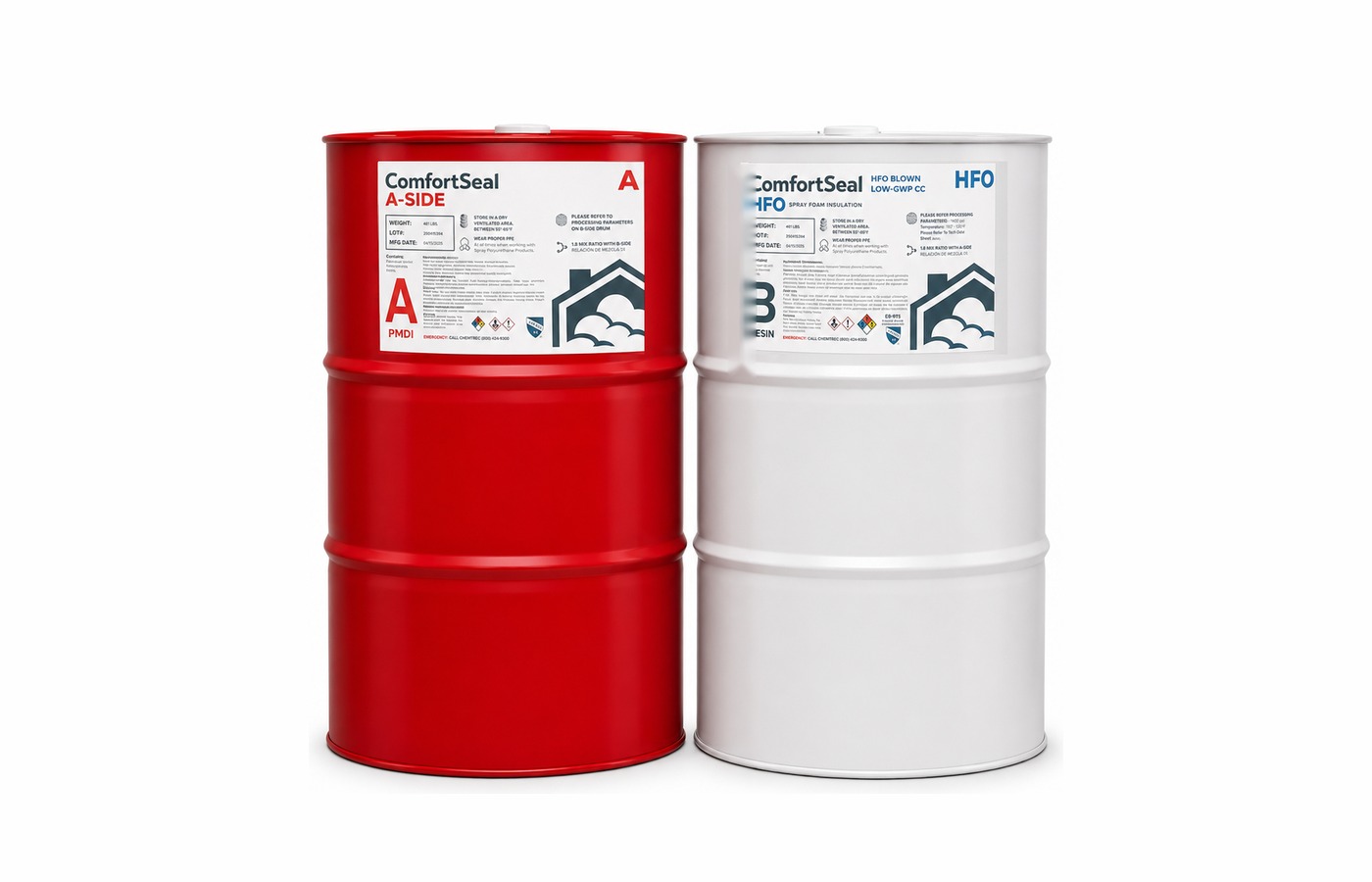
ComfortSeal HFO Closed Cell Spray Foam Insulation
ComfortSeal HFO is a two-component, 2.0 lb/ft³ closed-cell spray polyurethane foam insulation blown with an HFO agent (GWP 1), made by USAFoam, LLC. It is R-25 at 3.5 inches and R-39 at 5.5 inches (IAPMO ER-975, Table 1), a Class II vapor retarder at 2 inches (0.45 perms, ASTM E96), Class I under ASTM E84, and tested to 210 psf wind uplift (UL 1897).
The higher R-value at any given thickness in the ComfortSeal line, with vapor control and a 210 psf wind uplift rating as tested (UL 1897). A medium density closed cell foam that cures rigid, blown with an HFO agent that has a global warming potential of 1.
Every number, with its test method
Transcribed from the ComfortSeal HFO technical data sheet and IAPMO ER-975.
| Property | Value | Test method |
|---|---|---|
| R-value at 3.5 in. (2x4 wall) | R-25 | ASTM C518; ER-975 Table 1 |
| R-value at 5.5 in. (2x6 wall) | R-39 | ASTM C518; ER-975 Table 1 |
| R-value per inch | R-7.3 at 1 in., falling to R-7.0 to R-7.1 at 3.5 to 12 in. The R-value per inch of this insulation varies with thickness. The thicker the insulation, the lower the R-value per inch. The higher the R-value, the greater the insulating power. Ask your seller for the fact sheet on R-values. | ASTM C518 |
| Core density | 2.0 lb/ft³ | ASTM D1622 |
| Closed cell content | >92% | ASTM D2856 |
| Compressive strength | 29.5 psi | ASTM D1621 |
| Tensile strength | 56.8 psi | ASTM D1623 |
| Water absorption | 1.44% change | ASTM D2842 |
| Water vapor permeance | 0.45 perms at 2 inches | ASTM E96 |
| Dimensional stability | 6.5% | ASTM D2126 |
| Wind uplift resistance | 210 psf | UL 1897 |
| Fungi resistance | No growth | ASTM G21 |
Per-inch range from IAPMO ER-975, Table 1. Specifications verified against IAPMO ER-975 on September 29, 2026.
| Test | Result | Method |
|---|---|---|
| Flame spread | Class I — pass (≤25), tested at up to 4 in. | ASTM E84 |
| Smoke developed | Class I — pass (≤450), tested at up to 4 in. | ASTM E84 |
| Thermal barrier | Prescriptive ½-in. gypsum at any thickness, or a 15-minute coating at 14 wet / 9 dry mils: DC315 for foam up to 5.5 in. on walls, 9.5 in. on ceilings; No-Burn Plus ThB up to 7 in. on walls, 10 in. on ceilings (ER-975 Table 2) | NFPA 286 |
| Ignition barrier | No coating, provided the attic or crawl space is entered only to service utilities, has no storage, isn't interconnected, doesn't circulate air to the house, and foam is ≤10 in. on the roof deck / ≤6 in. on walls (ER-975 §4.5.2.2). The space still needs a thermal barrier to living areas. | ICC-ES AC377 App. X |
How much R you get at each depth
IAPMO ER-975, Table 1. Values are calculated from tested k-values at 1 and 4 inches, at a 75°F mean temperature.
| Installed thickness | R-value |
|---|---|
| 1 in. | R-7.3 |
| 3.5 in. (2x4 wall) | R-25 |
| 4 in. | R-28 |
| 5.5 in. (2x6 wall) | R-39 |
| 7.25 in. | R-51 |
| 9.25 in. | R-65 |
| 11 in. | R-77 |
| 12 in. | R-84 |
Installed thickness in inches · thickness steps are not evenly spaced
Go deeper on closed cell foam
Best applications
Exterior walls
R-25 in a 2x4 cavity and R-39 in a 2x6, the higher R-value ComfortSeal fits in either, plus a vapor retarder in the same pass.
Crawl spaces
No ignition barrier coating in service-only crawl spaces, up to 6 inches on walls (IAPMO ER-975). Absorbs 1.44% water (ASTM D2842); not for contact with soil or standing water (ER-975).
Unvented attics
Sprayed to the underside of the roof deck, up to 10 inches with no ignition barrier coating in service-only attics (IAPMO ER-975).
Humid climates and high-wind zones
A Class II vapor retarder at 2 inches, 210 psf wind uplift as tested (UL 1897), and no fungal growth (ASTM G21).
Processing parameters
Starting targets. Temperatures and pressures vary with ambient conditions, substrate, humidity, elevation and equipment — watch the foam and adjust.
| Parameter | Target |
|---|---|
| Mixing ratio | 1 : 1 by volume |
| Processing pressure | 1200–1450 psi |
| Primary heater and hose | 110–120°F (43–49°C) |
| Recirculation | Do not recirculate — warm drums to 75°F before use |
| Substrate and ambient | Above 45°F summer, above 14°F winter |
| Substrate moisture | Below 18% |
| Maximum per pass | 3 inches (IAPMO ER-975 §4.5) |
| Liquid component | A-side (ISO) | B-side (resin) |
|---|---|---|
| Color | Brown | Amber |
| Viscosity at 77°F | 185–230 cps | 400–520 cps |
| Specific gravity | 1.25 | 1.17–1.19 |
| Storage temperature | 70–80°F | 70–80°F |
| Shelf life, unopened | 6 months | 6 months |
ComfortSeal HFO FAQ
What is the R-value of ComfortSeal HFO?+
IAPMO ER-975 lists R-25 at 3.5 inches, R-28 at 4 inches and R-39 at 5.5 inches, calculated from k-values tested to ASTM C518. The chart on this page shows every depth from 1 to 12 inches.
Is ComfortSeal HFO a vapor barrier?+
No — it is a Class II vapor retarder, not a Class I vapor barrier: 0.45 perms at a minimum of 2 inches, per ASTM E96 and IAPMO ER-975.
Does it need an ignition barrier in attics and crawl spaces?+
No coating, provided the attic or crawl space is entered only to service utilities, has no storage, isn't interconnected, doesn't circulate air to the house, and the foam is no more than 10 inches on the roof deck or 6 inches on walls (IAPMO ER-975 Section 4.5.2.2). The space still needs a thermal barrier between it and the living areas.
What is the global warming potential?+
It uses an HFO blowing agent with a global warming potential of 1.
Is ComfortSeal HFO rated for high winds?+
It is wind uplift rated to 210 psf under UL 1897.
Ready to spray ComfortSeal HFO?
Talk to our team about pricing and supply, or find a certified installer for your project.