
Crawl spaces are easy to ignore. They're dark, cramped and out of sight. But the air down there doesn't stay down there. It moves up into the house through gaps in the floor, around pipes and along ductwork. A damp, drafty crawl space can mean cold floors, musty smells and humidity problems in the rooms above.
Spray foam can do a lot of good in a crawl space, but the product matters less than the plan. Before anyone sprays anything, you need to decide whether the crawl space stays vented or gets closed, deal with water and follow the code path for your area. Here's what to know.
Vented vs. closed crawl spaces
A vented crawl space has openings in the foundation walls that let outside air move through it. The 2021 International Residential Code, Section R408, sets the minimum: at least 1 square foot of net vent area for every 150 square feet of crawl space, with one vent within 3 feet of each outside corner. The vent area can drop to 1/1,500 of the floor area when the ground is covered with an approved Class I vapor retarder. In a vented crawl space, the insulation usually goes in the floor above, and the crawl space is treated as outdoors.
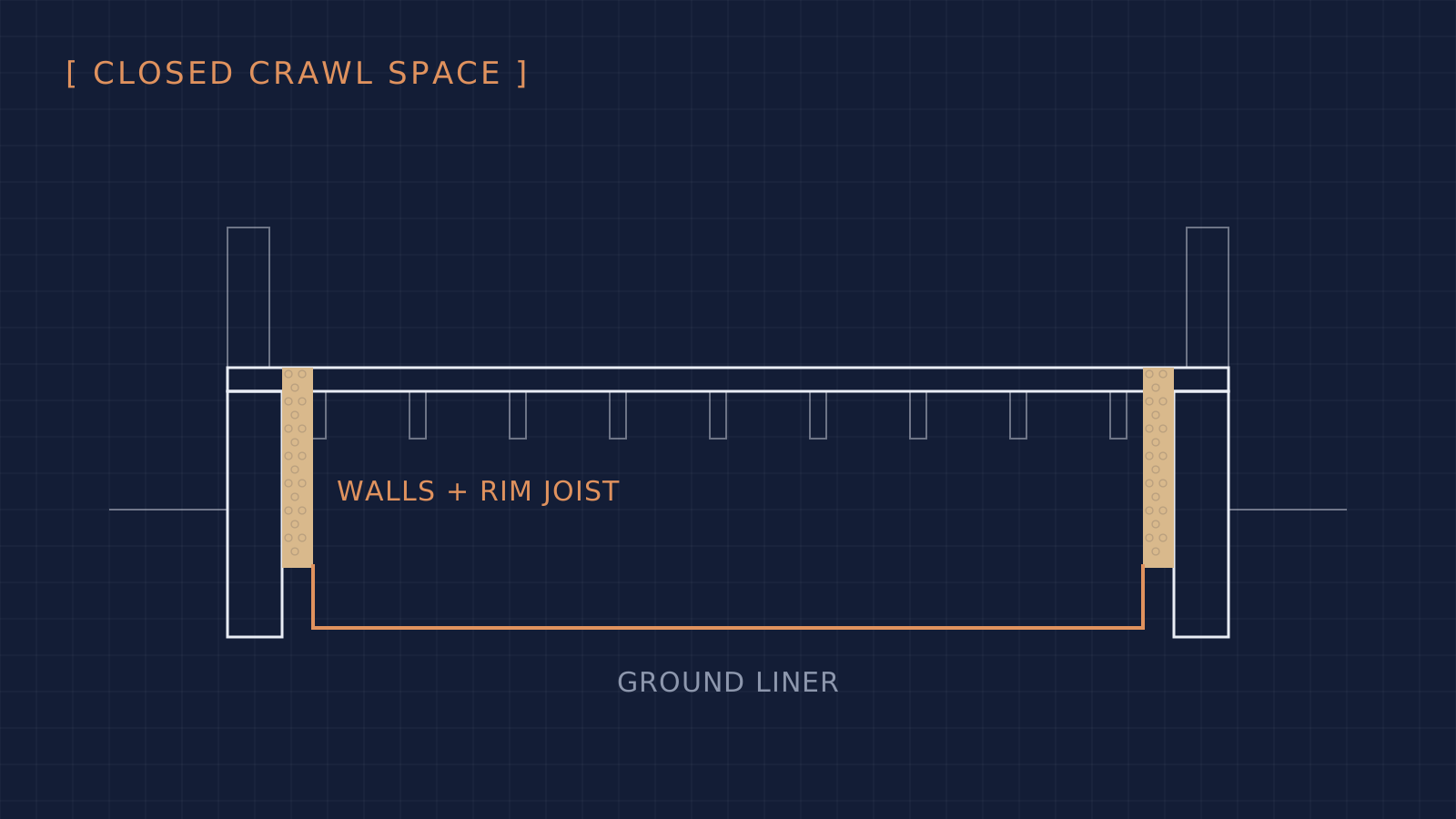
A closed crawl space (the code calls it an unvented crawl space) is sealed from the outside and treated as part of the house. Under IRC R408.3, it needs two things:
- A sealed ground cover. Exposed earth is covered with a continuous Class I vapor retarder. Joints overlap by 6 inches and are sealed or taped, and the edges run at least 6 inches up the stem wall and are attached and sealed to the wall or the insulation.
- A way to keep the air dry. One of the following: continuously running exhaust ventilation at 1 cubic foot per minute for each 50 square feet of floor area; a conditioned air supply at the same rate with a return path to the house; use as a plenum in existing homes that meet the mechanical code; or mechanical dehumidification. The IRC's closed-crawl-space provision (R408.3) sizes dehumidification at 70 pints per day per 1,000 square feet. The first two options also require the perimeter walls to be insulated.
| Feature | Vented crawl space | Closed crawl space |
|---|---|---|
| Foundation vents | Open (IRC R408.2) | Sealed (IRC R408.3) |
| Insulation location | Floor above the crawl space | Perimeter walls and rim joists |
| Ground cover | Optional; reduces required vent area | Required: sealed Class I vapor retarder |
| Drying method | Outside air through vents | Exhaust, conditioned air, plenum or dehumidifier |
| Ducts in the crawl space | Outside the envelope | Inside the envelope |
Why many humid-climate homes close the crawl space
Vents were meant to dry crawl spaces out. In humid climates they often do the opposite. Warm, moist outdoor air comes in and meets cooler floor framing and ductwork, and the moisture condenses. The Department of Energy's Building America guide Energy Renovations: Insulation (PNNL and ORNL, 2012) says a vented crawl space in a humid climate is vulnerable to serious moisture problems, and that adding insulation to its ceiling raises the risk of mold and wood rot. For humid climates outside flood-prone areas, it recommends closing the vents, air sealing the crawl space walls and floor, and insulating the walls. In dry and marine climates, it says vented and closed crawl spaces can both perform well.
Building Science Corporation's Information Sheet 512, published through ENERGY STAR, goes further. It recommends building crawl spaces as "mini-basements," with the ground vapor sealed, the walls insulated and air sealed, and the floors above left uninsulated.
Closing a crawl space isn't a decision to make casually, though:
- Test for radon first. The DOE guide says to test before closing a crawl space and to install a radon mitigation system if levels are high, because radon can build up in a closed crawl space.
- Check fuel-burning appliances. ENERGY STAR advises having gas or oil appliances tested to make sure they draft properly before and after sealing, because sealing can cause some appliances to backdraft.
- Ask your building department. The DOE guide notes that some areas don't permit closed crawl spaces, and local amendments to the IRC can change the details.
Termites are part of the plan too. Both evaluation reports (ER-974 Section 2.3 and ER-975 Section 2.6) say that in areas where the probability of termite infestation is "very heavy," the foam must be installed in accordance with IBC Section 2603.8 or IRC Section R318.4. In practice those sections govern the clearance between foam and exposed earth and keep an inspection gap so a pest inspector can see the foundation. Much of the Gulf Coast falls in the "very heavy" band, so ask your installer and building department how the gap and clearance will be handled before the foam goes on the walls.
Rim joists: a common air leak
The rim joist is the band of framing that sits on top of the foundation wall, where the floor joists end. ENERGY STAR lists the gaps between rim joists and under the sill plate as a common source of air leaks in basements and crawl spaces. It's a hard spot to insulate well with batts, because every joist bay is a small, irregular box with wiring and plumbing running through it.
BSC Information Sheet 512 says the rim joist assembly should be insulated with air-impermeable insulation (or insulated on the outside), so that humid indoor air can't reach the cold framing and condense. Spray foam fits the job: it seals and insulates each bay in one pass and fills around whatever runs through it.
Crawl space walls: foam, not batts
In a closed crawl space, the insulation goes on the inside of the perimeter walls. The DOE guide says rigid foam and spray foam on the inside of closed crawl space walls give good results in most areas, and that fiberglass batts or cellulose should not be used against a crawl space wall because fiber insulation collects and holds moisture. It also cautions that in cold climates, insulating the inside of the wall can raise the risk of condensation at the sill plates, rim joists and joist ends. That's one more reason to have the design checked for your climate.
Why closed cell foam is the usual choice
Crawl spaces are damp places, so for most crawl spaces we point people to ComfortSeal HFO closed cell foam. Here's what its data sheet and IAPMO evaluation report ER-975 show:
- Vapor control. 0.45 perms at 2 inches, which qualifies it as a Class II vapor retarder under the IRC.
- Moisture and mold resistance. Over 92% closed cell content, a 1.44% change in water absorption (ASTM D2842) and no fungal growth when tested to ASTM G21.
- R-value in a small space. R-25 at 3.5 inches and R-39 at 5.5 inches, from ER-975 Table 1.
It has limits, and your installer should respect them. ER-975 says the foam must not be in contact with soil or water, and it's applied at no more than 3 inches per pass. In practice that means foam goes on the foundation walls and rim joists, never on the dirt floor. Standing water and drainage problems have to be fixed before any insulation goes in.
ComfortSeal 500 open cell is also recognized for crawl spaces in IAPMO ER-974, and some building science guidance lists open cell foam as an option for crawl space walls. But it's vapor-open (21 perms at 1 inch) and can take on water, which makes it less forgiving in a damp crawl space. The 2009 DOE Building America guide Which Spray Foam Is Right for You? preferred closed cell for crawl space foundation walls for that reason. For the full comparison, see open cell vs. closed cell spray foam.
Coatings and the code path
Spray foam is a foam plastic, so the code requires fire protection over it. In a crawl space that people enter only to service utilities, the IRC allows an ignition barrier instead of a full thermal barrier. Here's how the two ComfortSeal reports handle it:
- ComfortSeal HFO can be left uncoated in a crawl space under ER-975 Section 4.5.2, up to 6 inches thick on walls and other vertical surfaces and up to 10 inches on the underside of the floor above, if all of the report's conditions are met. Entry is only to service utilities, with no storage. The crawl space isn't connected to other crawl or attic areas. Air from the crawl space isn't circulated to other parts of the building. Ventilation and combustion air are provided as the code requires. The crawl space must still be separated from the living space by a thermal barrier.
- ComfortSeal 500 needs a prescriptive ignition barrier or the coatings listed in ER-974 Table 5 in crawl spaces: DC315 at 6 wet / 4 dry mils (up to 9.5 inches of foam on walls) or No-Burn Plus ThB at 4 wet / 3 dry mils (up to 10 inches on walls), both up to 14 inches on the underside of the floor above.
One detail to raise with your installer: if a closed crawl space design supplies conditioned air with a return path to the house, or uses the crawl space as a plenum, the "air isn't circulated to other parts of the building" condition may not be met. In that case the no-coating path may not apply, and a coating or prescriptive ignition barrier may be needed. Also note that both reports cover Type V construction under the IBC and one- and two-family dwellings under the IRC. Your building official has the final say. Our guide to ignition barriers vs. thermal barriers covers the details.
A sensible order of operations
- Fix water first. Grading, gutters, downspouts, plumbing leaks and any standing water. Insulation doesn't solve a wet crawl space.
- Test for radon and plan mitigation if it's needed.
- Talk to the building department and decide: vented or closed.
- Install the ground vapor retarder to IRC R408.3 if you're closing the space.
- Seal the vents and air leaks, then insulate the rim joists and walls with the right foam at the right thickness.
- Set up the drying method the code requires, working with your HVAC contractor.
- Apply any required coating and have fuel-burning appliances checked.
Decide vented or closed first, fix water before insulating, and follow IRC R408 and the product's evaluation report. In most closed crawl spaces, closed cell foam on the rim joists and walls handles air sealing, insulation and vapor control in one step, as long as it stays off the soil and away from standing water.
Installs by certified ComfortSeal installers carry a limited lifetime warranty on the foam, for the life of the home; installation workmanship is the installing contractor's responsibility. To have your crawl space evaluated, find a certified ComfortSeal installer. Builders can also talk through an assembly with our team.
Frequently asked questions
Should a crawl space be vented or closed before adding spray foam?
It depends on climate and local code. IRC R408.3 allows a closed (unvented) crawl space with a sealed Class I ground vapor retarder and a drying method such as exhaust, conditioned air or dehumidification. The DOE Building America guide recommends closing crawl spaces in humid climates outside flood-prone areas; in dry and marine climates either approach can work. Ask your building department first.
Which spray foam is usually used in a crawl space?
Most closed crawl spaces use closed cell foam. ComfortSeal HFO rates 0.45 perms at 2 inches, a Class II vapor retarder, shows no fungal growth under ASTM G21 and delivers R-25 at 3.5 inches (IAPMO ER-975). ComfortSeal 500 open cell is also recognized for crawl spaces in ER-974, but it is vapor-open and less forgiving in damp conditions.
Can spray foam be applied to the crawl space floor or soil?
No. ER-975 says ComfortSeal HFO must not be in contact with soil or water. The foam goes on the foundation walls and rim joists above a sealed ground vapor retarder, and standing water or drainage problems have to be fixed before any insulation is installed.
Does spray foam in a crawl space need a fire-protective coating?
Sometimes. In a crawl space entered only to service utilities, ComfortSeal HFO can be left uncoated under ER-975 Section 4.5.2 within its thickness limits and conditions. ComfortSeal 500 needs a prescriptive ignition barrier or a coating listed in ER-974 Table 5. If the crawl space is used as a plenum or supplies air to the house, the no-coating path may not apply. Your building official decides.