
ComfortSeal is made by USAFoam, LLC in Mandeville, Louisiana, so these questions come from our own region. Spray foam insulation in Louisiana has more than heat to deal with: humid air, a termite map shaded "very heavy" statewide, flood zones and coastal wind. None of that changes what the foam is. It changes which foam goes where and how it's detailed.
We cover the Louisiana code first, then each Gulf South concern. For general building science, see our post on spray foam in humid and coastal climates.
Louisiana's climate in one paragraph
The 2021 International Energy Conservation Code (IECC) gives every county and parish a climate zone in Table R301.1. It lists most of Louisiana as zone 2A, where "A" means moist. A band of northern parishes, including Caddo, Bossier, Ouachita and Lincoln, is listed as 3A. Louisiana's amendment overrides that: "for energy purposes only, all of Louisiana shall be a climate zone 2A" (LAC 17:I-117). Nearly every parish carries the table's warm-humid flag, as do neighbors such as Hancock, Harrison and Jackson counties on the Mississippi coast and Jefferson and Orange counties in southeast Texas, all zone 2A. That humid air drives most of the choices below.
What the code in Louisiana asks for
Louisiana adopts statewide codes through the Louisiana Uniform Construction Code Commission (LUCCC). Its code information sheet (revised August 6, 2026) says the 2021 International Residential Code (IRC) took effect January 1, 2023, and the 2021 IECC on July 1, 2023. The LUCCC approved adoption language for the 2024 codes on July 7, 2026, with January 1, 2027 listed as their effective date, so check which edition applies on your permit date. Under LAC 17:I-107, the IRC is mandatory for new construction, reconstruction, additions to homes previously built to the IRC, and extensive alterations.
The IRC's energy chapter, with Louisiana's amendments, sets these prescriptive minimums for a zone 2 house (Table N1102.1.2):
- Ceiling: R-38.
- Wood-frame walls: R-13 in the cavity, or R-10 continuous insulation.
- Floors: R-13.
- Windows: U-factor no higher than 0.40, and solar heat gain coefficient no higher than 0.25.
Louisiana also amends the air-sealing and duct rules:
- Blower door test. Every dwelling is tested, with a limit of 7.0 air changes per hour at 50 pascals. Since July 1, 2024, the tester must be certified, and a home that tests below 3 air changes per hour needs whole-house mechanical ventilation.
- Ducts. Ducts outside conditioned space need at least R-8, and in zone 2A they may not be buried in insulation.
- Unvented attics. When insulation at the roof line creates an unvented attic, the HVAC system has to be sized or modified to current code, and insulation between the attic and the living space has to come out.
- Insulation certificate. A Louisiana Insulation Certificate must be permanently posted in a utility area.
For the foam, the numbers come from the IAPMO evaluation reports. ComfortSeal 500 open cell gives R-13 at 3.5 inches (ER-974 Table 1), which meets the zone 2 wall minimum in a 2x4 cavity. ComfortSeal HFO closed cell gives R-25 at 3.5 inches and R-39 at 5.5 inches (ER-975 Table 1). See the full tables in our R-value by thickness guide.
Which foam goes where in a Gulf South house
A starting point for the conversation with your installer and building official:
| Location | Usual choice | Why | Code / report note |
|---|---|---|---|
| Attic roof deck | Either foam; HFO gives R-39 at 5.5 in | Puts the attic and its ducts inside the envelope | IRC R806.5 and the Louisiana unvented-attic rules. HFO can be uncoated only in attics entered just for service, with no storage and no attic air circulated to the house, up to 10 in on the deck (ER-975 §4.5.2.2). ComfortSeal 500's air-leakage result (ASTM E283, data sheet) is what makes it air-impermeable insulation under R806.5; confirm with the building official. |
| Exterior walls | 500 (R-13 at 3.5 in) or HFO (R-25 at 3.5 in) | Zone 2 wall minimum is R-13 | No interior poly (IRC R702.7). Ask how HFO's Class II rating is treated in the wall. |
| Interior walls | 500 | Sound control: NRC 0.75 (ASTM C423) and STC 39 (ASTM E413), from the ComfortSeal 500 data sheet | Separated from the room by a thermal barrier, such as 1/2-inch gypsum wallboard (ER-974). |
| Raised floor or crawl space | HFO | Class II vapor retarder at 2 in; low water absorption | Needs a subfloor, weather protection and 6 in clearance from exposed earth. |
| Rim joists | HFO | Seals and insulates irregular framing bays | Same termite clearance (IRC R318.4). Max 3 in per pass. |
| Metal buildings | Check scope first | The reports cover specific construction types | ER-974 and ER-975 cover Type V (IBC) and IRC dwellings only. |
R-values are installed values at the stated thickness from IAPMO ER-974 and ER-975 Table 1. The higher the R-value, the greater the insulating power. Ask your seller for the fact sheet on R-values. Both foams are nonstructural insulation.
Humidity, vapor and why there's no plastic behind the drywall
Cold-climate walls get polyethylene on the inside face. In Louisiana that's backwards. The DOE's Building America Solution Center explains that when indoor air is cooler and drier than outdoor air, water vapor moves through the wall from outside in. An interior vapor retarder becomes the cool surface where it condenses, with no way to dry inward. For warm-humid climates, it says any vapor retarder in the wall should be Class II or Class III.
The code goes further. IRC R702.7, as adopted in Louisiana, doesn't require a vapor retarder in zones 1 through 3. Its Table R702.7(2) lists Class I and Class II vapor retarders as not permitted on the interior side of frame walls in zones 1 and 2, unless the product measures above 1 perm by the ASTM E96 water method. Class III, such as latex paint, is permitted.
- ComfortSeal 500 is vapor-open (21 perms at 1 inch), so it adds no interior vapor barrier.
- ComfortSeal HFO is itself a Class II vapor retarder (0.45 perms at 2 inches, ER-975 Section 4.6). If you plan closed cell in exterior walls, ask your designer and building official how they apply R702.7 there. The section allows an approved hygrothermal design as an alternative.
Attics need the same thinking. IRC R806.5 allows an unvented attic that sits completely inside the building thermal envelope. Air-impermeable insulation goes in direct contact with the underside of the roof sheathing. Air-permeable deck insulation in zones 1 to 3 also needs a vapor diffusion port near the ridge, a 3:12 or steeper roof and supply air (item 5.2). Our guide to unvented attics covers the rest.
Termites and foam near the ground
The IRC's termite infestation probability map (Figure R318.4) shades all of Louisiana "very heavy," along with much of the Gulf South. The LSU AgCenter calls the Formosan subterranean termite "the most destructive structural pest in Louisiana." It was first reported in the port cities of Lake Charles and New Orleans and has spread to 42 of the state's 64 parishes. Native subterranean termites are found throughout the state as well.
In "very heavy" areas, IRC R318.4 sets two limits on foam plastics:
- Not on or under below-grade foundations. Foam can't go on the exterior face of foundation walls or slab foundations below grade, or under them.
- 6 inches of clearance. Foam installed above grade has to stay at least 6 inches from exposed earth.
Exceptions include buildings framed entirely in noncombustible materials or pressure-preservative-treated wood. Both ComfortSeal evaluation reports require compliance with R318.4 in these areas (ER-974 Section 2.3, ER-975 Section 2.6).
Flood zones and foam below the base flood elevation
In a Special Flood Hazard Area (Zone A or V on the flood map), the National Flood Insurance Program requires flood damage-resistant materials below the base flood elevation (BFE). The IRC carries this up to its own required elevation, generally the BFE plus 1 foot. The Louisiana IRC (Section R322.1.8) points to FEMA's Technical Bulletin 2 for what qualifies.
The January 2025 edition rates materials as acceptable or unacceptable. A flood damage-resistant material has to take at least 72 hours of direct contact with floodwater and need no more than cosmetic repair afterward. For insulation, TB 2's Table 2 says:
- Acceptable: "Sprayed polyurethane foam (SPUF) or closed-cell plastic foams," for both floors and walls.
- Unacceptable: fiberglass, mineral wool and "all other types," with open-cell plastic foams named as an example.
So below the BFE, open cell foam such as ComfortSeal 500 is out, and closed cell is what TB 2 accepts. ComfortSeal HFO's water absorption is 1.44% (ASTM D2842). "Acceptable" rates how a material holds up after floodwater. It doesn't mean it keeps water out, and ER-975 still says the foam must not be installed in contact with rain, water or soil. Your local floodplain administrator decides what's allowed on your lot.
Wind and hurricanes: what foam does and does not do
Along the Louisiana coast, the IRC's map of regions where wind design is required (Figure R301.2.1.1) marks a coastal band. In those areas, Section R301.2.1.1 requires the design for wind loads to follow one or more listed methods, such as the AWC Wood Frame Construction Manual, ICC 600 or ASCE 7. The roof sheathing, how it's fastened and the rest of the wind-resisting structure belong to that design.
Spray foam isn't part of that structure; both evaluation reports list ComfortSeal as nonstructural insulation. ComfortSeal HFO's 210 psf wind uplift result under UL 1897 is a test result for the foam. It isn't a hurricane rating for a house, and it doesn't replace any nail, strap or sheathing panel the design calls for.
The same goes for Louisiana's Fortify Homes Program, which the Louisiana Department of Insurance runs to the IBHS FORTIFIED Roof standard. The FORTIFIED Roof requirements it posts cover 8d ring-shank deck nailing, a minimum deck thickness, a sealed roof deck (for example, seam tape with underlayment, or self-adhered underlayment) on top of the sheathing, new drip edge and a starter strip. Spray foam under the deck isn't one of those requirements, so it isn't a route to a FORTIFIED designation.
Raised and pier-and-beam homes
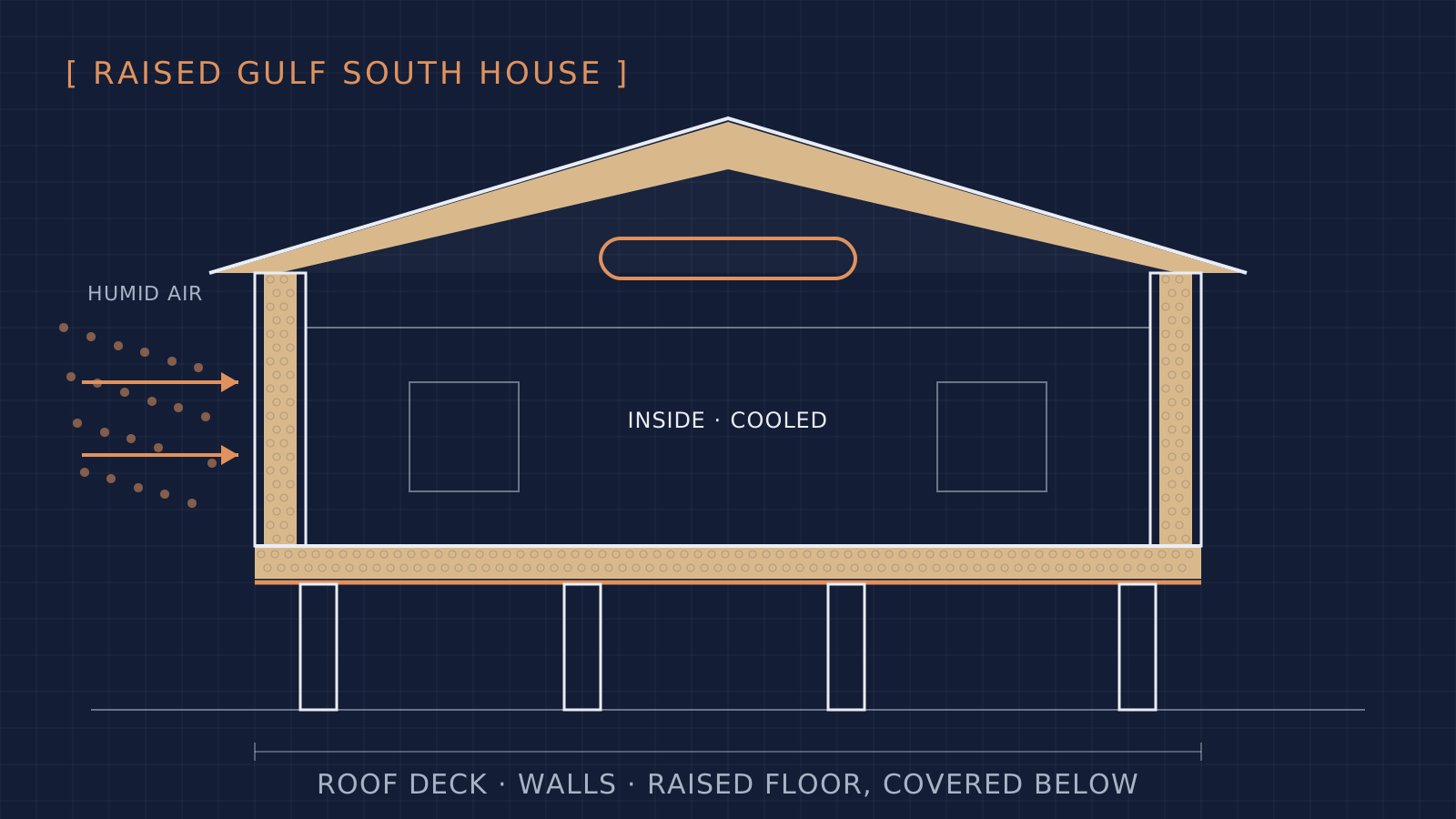
Many south Louisiana houses sit on piers, with the floor open to outdoor air. Three rules apply:
- There has to be a subfloor. Louisiana's amendment to the floor insulation section says plastic spray foam can't be applied to finish flooring where no subfloor exists (N1102.2.7).
- The foam needs cover below. ER-975 says ComfortSeal HFO must be protected from weather during and after application. ER-974 requires weather protection for ComfortSeal 500 during installation. On an open-air underside, plan a covering, such as sheathing across the bottom of the joists, and ask the building official which covering meets the fire-protection rules there.
- Termite clearance still applies. Foam has to stay at least 6 inches above exposed earth (IRC R318.4).
The zone 2 floor minimum is R-13. For a floor open to outdoor air, we generally point people to closed cell for its Class II vapor retarder rating and low water absorption; ask for the thickness and matching R-value from ER-975 Table 1. If the space under the house is enclosed as a crawl space instead, see our crawl space guide.
What to ask a Louisiana installer
- Which evaluation report covers the foam? For ComfortSeal, IAPMO ER-974 (ComfortSeal 500) or ER-975 (ComfortSeal HFO).
- What thickness goes where, and what R-value does that report's Table 1 give at that thickness?
- What covers the foam in each spot? In attics and crawl spaces entered only to service utilities, ComfortSeal 500 needs an ignition barrier or an ER-974 Table 5 coating, such as DC315 at 6 wet / 4 dry mils or No-Burn Plus ThB at 4 wet / 3 dry mils. In living spaces it needs a thermal barrier, such as 1/2-inch gypsum wallboard or DC315 at 18 wet / 12 dry mils (Table 4). See ignition vs. thermal barriers.
- Where does the foam stop above the soil? (IRC R318.4)
- Is any work below the base flood elevation, and which foam goes there?
- Who runs the blower door test, and are they certified?
- What's your ComfortSeal certificate number? Check it on our verify page.
Louisiana is zone 2A statewide for energy code purposes. Keep plastic vapor barriers off the inside of walls, keep foam 6 inches clear of exposed earth, use closed cell below the base flood elevation and cover foam under raised floors. Treat spray foam as insulation, not structure, and take every R-value at the thickness listed in the evaluation report.
Installs by certified ComfortSeal installers carry a limited lifetime warranty on the foam, for the life of the home; workmanship is the installing contractor's responsibility. To get a project quoted, request a certified ComfortSeal installer. Builders can also talk through an assembly with our team.
Frequently asked questions
What climate zone is Louisiana in for insulation?
Zone 2A. The 2021 IECC county table lists a band of northern parishes as 3A. Louisiana's amendment (LAC 17:I-117) says that for energy purposes all of Louisiana is climate zone 2A.
Should I put a plastic vapor barrier behind the drywall in Louisiana?
No. In a hot, humid climate the vapor drive runs from outside in, so interior plastic becomes a cold surface where moisture condenses. IRC Table R702.7(2) lists Class I and Class II vapor retarders as not permitted on the interior side of frame walls in zones 1 and 2, unless they measure above 1 perm by the ASTM E96 water method.
Can spray foam be used below the base flood elevation?
FEMA rates closed cell as acceptable. FEMA Technical Bulletin 2 (2025) rates sprayed polyurethane foam or closed-cell plastic foams as acceptable flood damage-resistant insulation for floors and walls. Open-cell plastic foams fall in the unacceptable group. Your floodplain administrator has the final say.
Does spray foam make a Louisiana roof hurricane-ready?
No. ComfortSeal foams are nonstructural insulation. ComfortSeal HFO's 210 psf wind uplift result under UL 1897 is a test of the foam, not a rating for a house. Sheathing and nailing come from the structural design. Spray foam isn't one of the IBHS FORTIFIED Roof requirements.
Can I spray foam under an old raised house with no subfloor?
Not directly on the flooring. Louisiana's amendment to IRC N1102.2.7 says plastic spray foam can't be applied to finish flooring where no subfloor exists. With a subfloor, closed cell foam under an open-air floor still needs protection from weather (ER-975) and 6 inches of clearance from exposed earth.