
ComfortSeal is a brand of USAFoam, LLC, headquartered in Mandeville, Louisiana — so when we talk about building in humid, coastal climates, we're talking about the air outside our own front door. On the Gulf Coast, the building science conversation starts and ends with one word: moisture.
Heat, you can insulate against. Moisture is sneakier. It rides in on humid air through every gap in the envelope, drives through vapor-open materials toward the air-conditioned interior, and condenses wherever it finds a cool surface. Get the moisture strategy wrong and no R-value on the plans will save the assembly. Here's how spray foam — and specifically which spray foam, where — fits coastal construction.
Why humid climates punish ordinary insulation
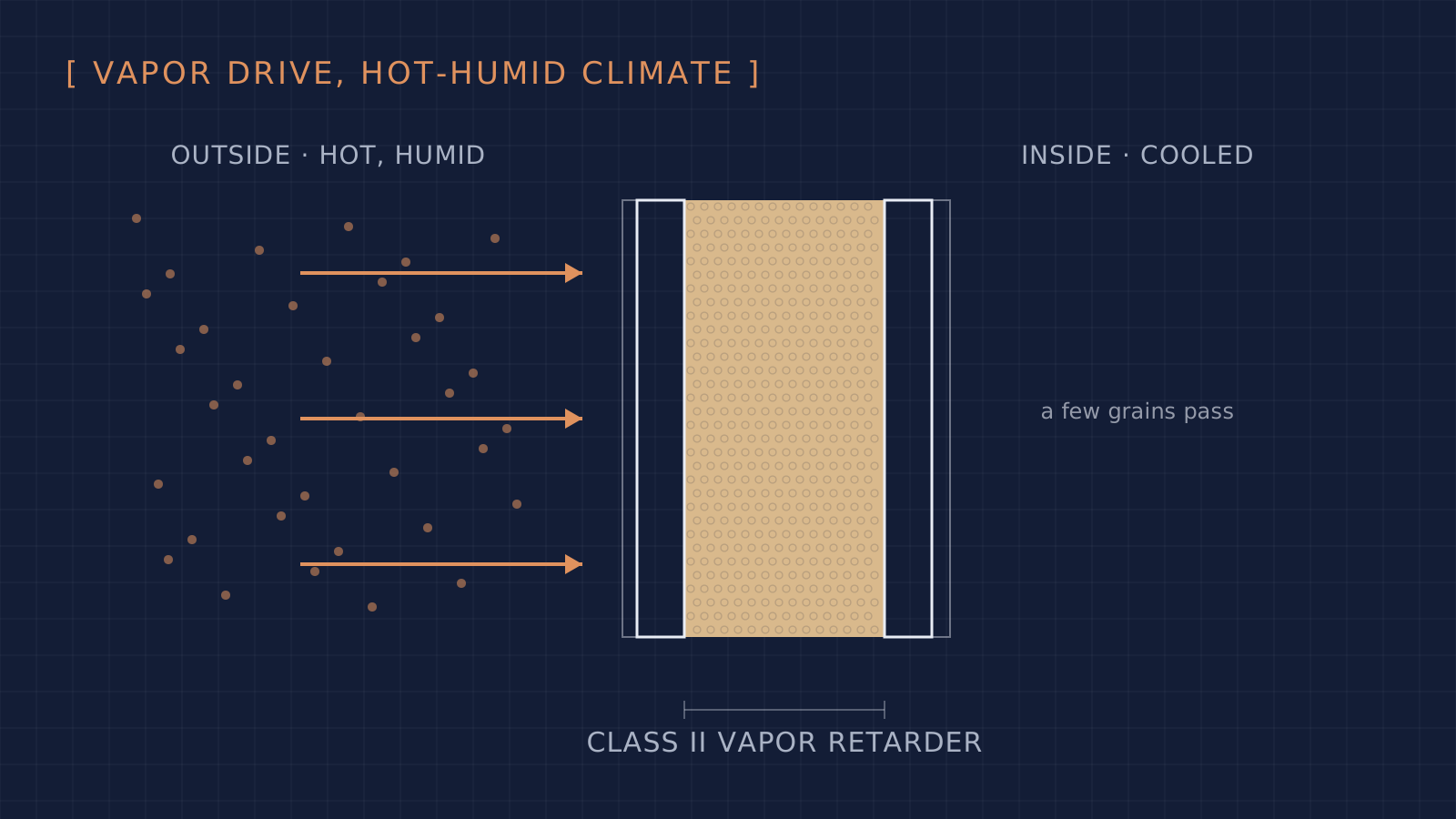
In a hot-humid climate, the vapor drive runs from outside in: moist exterior air pushing toward your cool, conditioned interior. Insulation that can't manage that reality becomes part of the problem. Fiberglass batts (roughly R-2.9 to R-3.8 per inch at standard density) and cellulose (roughly R-2.9 to R-3.8 per inch depending on the form, per the U.S. Department of Energy) don't stop air movement at all — batts leave gaps, and loose-fill can settle in an attic — so humid air moves through and around them freely, carrying water vapor into the assembly with it.
The first defense is airtightness itself. Spray foam creates a continuous airtight seal, and on the coast that seal does double duty: it keeps conditioned air inside, which helps the cooling bill, and it shuts off the main highway humid air uses to enter the assembly.
Where closed cell earns its keep on the coast
Airtightness alone isn't the whole strategy — vapor can still diffuse through materials. That's where ComfortSeal HFO closed cell foam becomes the Gulf Coast workhorse. It's a 2.0 lb/ft³ foam that brings four properties coastal builders should be spec'ing deliberately:
- A built-in vapor retarder. At 2 inches, ComfortSeal HFO rates 0.45 perms, a Class II vapor retarder — the insulation layer itself controls vapor drive, without a separate membrane to detail and hope nobody punctures.
- Nothing for moisture to feed on. Under ASTM G21 fungi-resistance testing, ComfortSeal HFO shows no growth. In a climate where damp assemblies are the default failure mode, insulation that won't support fungal growth is cheap insurance.
- Storm-zone resilience. ComfortSeal HFO is rated for 210 psf wind uplift (UL 1897), and it cures rigid.
- More R-value in the same depth. At R-25 in a 3.5-inch (2x4) cavity, against R-13 for open cell, it fits more thermal resistance into a coastal wall's limited cavity depth.
There are practical bonuses, too: no ignition barrier coating is required in service-only attics and crawl spaces (ICC-ES AC377 Appendix X, within ER-975's thickness limits), the HFO blowing agent has a GWP of 1, and evaluation report ER-975 gives your inspector everything they'll ask for.
Building in Florida? ER-975 carries a Florida supplement. It recognizes ComfortSeal HFO as an alternative under the 2023 Florida Building Code (Building, Residential and Energy Conservation), including locations in the High-Velocity Hurricane Zone, subject to the supplement's limitations: the clearance between foam installed above grade and exposed earth must follow FBC Building Section 2603.8 or FBC Residential Section R318.8 (the termite inspection gap), and a Commission-approved quality assurance agency must audit the manufacturer's program. The supplement expires with ER-975, so pull the current copy for the permit file.
On the coast, insulation isn't just a thermal decision — it's a moisture and storm decision. Closed cell foam is one material that answers all three at once: a Class II vapor retarder at 0.45 perms, no fungal growth (ASTM G21), and 210 psf wind uplift (UL 1897).
Where open cell still belongs in a coastal house
None of this makes open cell foam the wrong choice everywhere on the coast — it makes placement the decision. At the roof deck, IRC R806.5 sets the conditions for air-permeable insulation in an unvented attic by climate zone, so check them before specifying open cell there. Once the exterior shell is handled, ComfortSeal 500 open cell is an excellent fit inside the conditioned envelope: interior partition walls, attic assemblies within the sealed boundary, and anywhere sound control matters. Its ~100× expansion air-seals complex framing fast, it delivers R-13 in a 2x4 wall, and its NRC 0.75 / STC 39 acoustic ratings quiet the house — while the water-blown chemistry and Class I flame spread and smoke rating (ASTM E84, documented under ER-974) keep the spec clean.
A typical Gulf Coast pairing: ComfortSeal HFO on the exterior walls facing the weather, ComfortSeal 500 everywhere inside the sealed boundary. Two products, one truck, every assembly covered.
The conversation with the homeowner
Coastal homeowners don't need convincing that humidity and hurricanes are real — they live it. What they need is a builder or contractor who can connect the spec to their worries in plain language: the foam seals the house so the AC stops fighting the outdoor air, the closed cell layer is a vapor retarder that won't support fungal growth, and the same material is rated for 210 psf wind uplift (UL 1897). Installs by certified ComfortSeal installers carry a limited lifetime warranty on the foam, for the life of the home; installation workmanship is the installing contractor's responsibility. Put together, the premium line item starts sounding like the conservative choice.
Built where the humidity lives
ComfortSeal's roots are in Mandeville, Louisiana — Gulf Coast air is the environment this lineup was built to handle. If you're building or insulating where the air is heavy and the storms are real, we'd love to talk through your wall assembly. For the Louisiana code, termite clearance, flood zones and raised floors, see our guide to spray foam insulation in Louisiana.
Frequently asked questions
Why is closed cell spray foam recommended in humid climates?
Vapor drive on the coast runs from outside in. ComfortSeal HFO rates 0.45 perms at 2 inches, a Class II vapor retarder, so the insulation itself controls vapor diffusion without a separate membrane. It also shows no fungal growth under ASTM G21 and fits R-25 into a 3.5-inch wall (IAPMO ER-975).
Is spray foam rated for hurricane zones?
ComfortSeal HFO is rated for 210 psf wind uplift under UL 1897 and cures rigid. ER-975 also carries a Florida supplement recognizing it under the 2023 Florida Building Code, including the High-Velocity Hurricane Zone, subject to the supplement's termite-clearance and quality-assurance conditions. Pull the current copy for the permit file.
Can open cell spray foam be used in a coastal house?
Yes, inside the conditioned envelope: interior partitions, attic assemblies within the sealed boundary and anywhere sound control matters. ComfortSeal 500 gives R-13 in a 2x4 wall with NRC 0.75 and STC 39 (ER-974). At the roof deck, IRC R806.5 sets the climate-zone conditions for air-permeable insulation, so check them first.
Does spray foam stop humidity from getting into the walls?
It addresses two paths. The continuous air seal shuts off the main route humid air uses to enter the assembly. Closed cell's Class II vapor retarder rating then limits vapor diffusion through the material. Airtightness alone is not the whole strategy, which is why the placement of each foam matters.